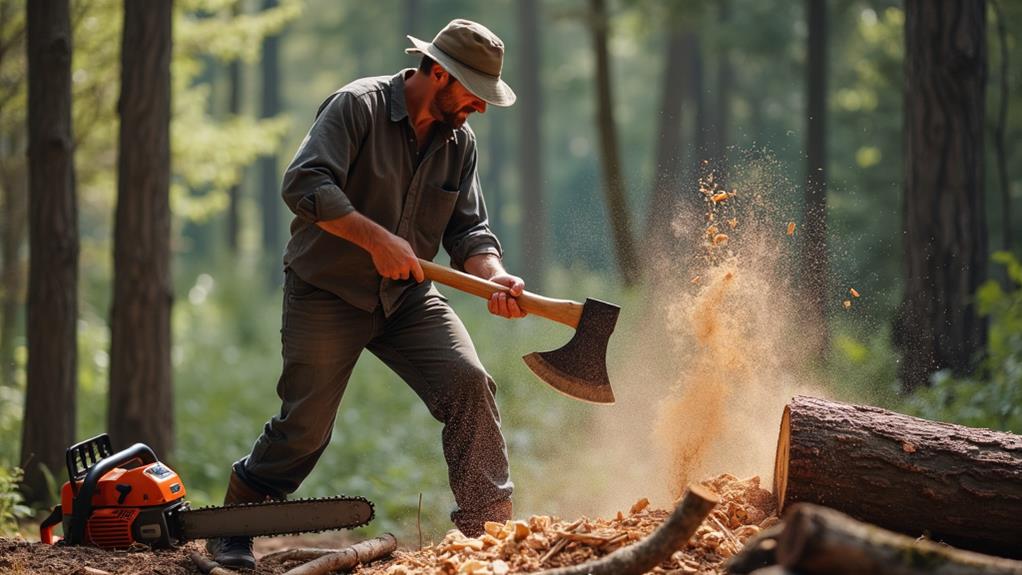
The Role of Axes in Traditional Logging

Axes were indispensable tools in traditional logging, particularly in industries like Michigan's thriving timber sector. Specialized axes, such as the Michigan Pattern Axe, significantly boosted productivity and transformed the timber industry. Each type of axe, from felling to splitting, had a distinct role, enhancing efficiency and precision. But what made these axes so effective, and how did loggers master the techniques to use them safely?
Let's delve into the details behind these essential tools and their impact on logging practices.
Historical Significance
Axes played an indispensable role in the early logging industry, driving the efficient felling of trees and land clearing that fueled Michigan's mid-19th century settlement expansion. The historical significance of axes in this period can't be overstated. They were the primary tools enabling loggers to cut through vast forests of Eastern White Pines, a task crucial for transforming dense woodlands into habitable land and supporting burgeoning communities.
The Michigan Pattern Axe, designed specifically for felling large trees, became a favorite among loggers. Its flared blade was perfect for cutting against the grain, making it an essential tool during peak logging operations. By the 1860s, the use of such axes, alongside saws, had doubled the number of sawmills in Michigan. This surge in productivity catapulted the timber industry's value from $1 million to $6 million.
Axes' historical significance lies not just in their role in clearing land but also in their impact on the economy. They were central to the logging techniques that preceded the advent of sawmills, marking a crucial shift towards more efficient timber processing.
This technological transformation showcased the evolving nature of the logging industry and its profound economic implications.
Types of Axes
In the realm of traditional logging, you'll encounter several specialized types of axes, each designed for a specific task. The most common is the felling axe, used primarily for chopping down trees and limbing. It typically features a 3½-pound head and a sturdy hickory handle, making it ideal for cutting across the grain of the wood.
Next are splitting axes, often known as mauls. These are crafted specifically for splitting firewood. Unlike felling axes, splitting axes act as handled wedges that require a downward swing to split along the grain, making the task of splitting logs more efficient.
Another crucial tool in traditional logging is the broad axe. After a log has been felled and roughly hewn, a broad axe is used to smooth its surface. Characterized by a wide bit and a short handle, the broad axe allows for vertical arcs during use, ensuring a smooth, flat surface. Broad axes come in right-handed and left-handed designs to accommodate different user preferences.
Each of these axes—whether it's the felling axe, splitting axe, or broad axe—plays a vital role in the traditional logging process, enhancing efficiency and precision.
Axe Anatomy
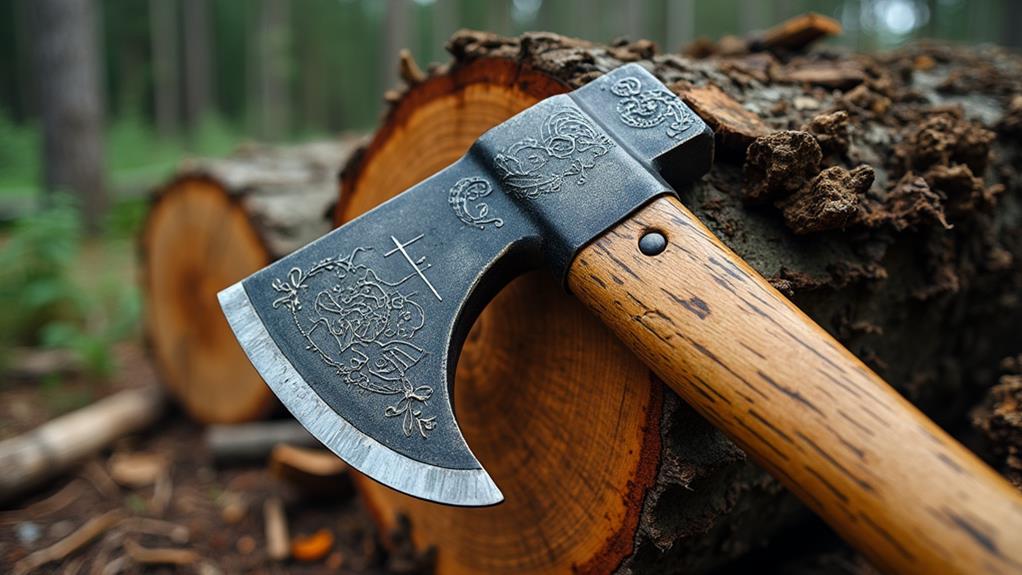
The anatomy of an axe primarily consists of the head, which includes the bit, poll, and cheeks—each serving a crucial function. The bit's shape can vary to accommodate different tasks, while the poll and cheeks contribute to the axe's overall balance and cutting efficiency. Understanding these components and their design will help you select the appropriate axe for your specific logging needs.
Key Axe Components
Understanding the key components of an axe is essential for maximizing its performance in traditional logging. The axe head consists of three main parts: the bit, the poll, and the cheeks.
Bit: The bit, or cutting edge, varies based on the type of axe and significantly affects its cutting efficiency. A well-designed bit can greatly improve your productivity.
Poll: Located opposite the bit, the poll is often weighted to add momentum to your swing, making it easier to deliver more forceful impacts.
Cheeks: Situated on the sides of the axe head, the cheeks support the bit and optimize cutting efficiency. They come in two primary shapes:
- Flat cheeks: Reduce the likelihood of the axe sticking in the wood.
- Convex cheeks: Help guide the axe through the cut more smoothly.
Bit Shape: Flared or thin designs are tailored for specific tasks like felling or limbing.
Each component of the axe head serves a distinct purpose, ensuring that your tool is balanced and efficient. Understanding these elements allows you to choose the right axe for different logging tasks.
Importance of Axe Design
Crafting an efficient axe is about more than just assembling parts; it's about creating a tool that balances form and function. Understanding axe design starts with the axe head, which is composed of three main parts: the bit, the poll, and the cheeks. The bit's design is crucial for its cutting ability. Felling axes have a sharp, thin tip to slice against the wood grain, while splitting axes feature a wedge shape for cutting along the grain.
Handle length significantly impacts an axe's performance. A longer handle provides greater leverage and power, while a shorter handle offers better control and precision. The best handles are typically made from hickory or ash, which provide superior grip and comfort compared to synthetic materials.
The weight of the axe head directly affects its cutting capability. Heavier heads generate more force, making them ideal for tough wood, but they can reduce accuracy. Lighter heads allow for deeper cuts but may lack the power needed for thicker logs.
A well-balanced axe enhances control and precision, making chopping tasks more efficient and less strenuous. Therefore, when choosing an axe, consider that thoughtful design is key to optimal performance.
Felling Techniques
Felling techniques in traditional logging rely on the effective use of the felling axe, a specialized tool designed with a flared shape and a sharp, thin edge for cutting against the grain of wood. Typically weighing two to four pounds and featuring handles often exceeding 30 inches, felling axes enable powerful swings necessary for precise cuts. The goal is to ensure the tree falls in the desired direction.
Key techniques include:
- Notch Cut: Begin by cutting a notch on the side of the tree facing the intended fall direction. This cut should extend about one-third of the way through the tree.
- Back Cut: Move to the opposite side and make a horizontal cut slightly above the bottom of the notch. This creates a hinge that guides the fall.
- Wedges: Insert wedges into the back cut to prevent the saw from binding and to help control the fall direction.
Mastering these techniques ensures safety and efficiency, allowing for controlled tree descent while minimizing damage to the surrounding area.
Limbing and Bucking
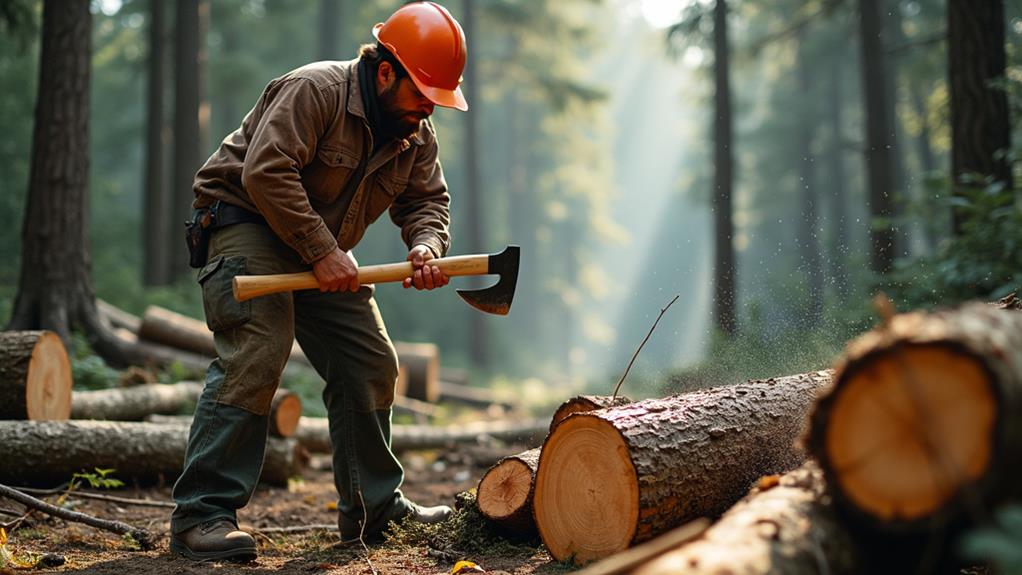
How do you efficiently process a felled tree? Start by focusing on limbing and bucking. Initially, let's tackle limbing, which involves removing branches from the tree. A swamping axe with a sharp edge and a lightweight design is perfect for this task. The wooden handle of the axe provides a good grip and balance, reducing fatigue as you work through the branches. A two-man crosscut saw is also commonly used, especially for thicker limbs.
Next, move on to bucking, which means cutting the felled tree into manageable sections. Precision is key to optimize the usability of the timber. Using a two-man saw or a felling saw, cut through the trunk at specific intervals.
Wooden or metal wedges are useful during this process; insert them into the cuts to keep them open, ensuring smoother sawing and preventing the saw from binding in the log.
Modern Applications
Modern forestry practices still rely on axes for tasks like felling, limbing, and splitting. Technological advancements have led to ergonomic designs and durable materials, making these tools highly effective. Although chainsaws are predominant, axes remain crucial for precision work and as reliable backups in logging operations.
Current Forestry Practices
Modern forestry practices emphasize sustainability and efficiency, moving beyond traditional methods of logging and tree felling. The current focus is on maintaining forest health while meeting timber demands through responsible and advanced techniques.
Selective cutting is commonly employed to minimize ecological impact, ensuring the forest can continue to thrive. Certification programs, such as those offered by the Forest Stewardship Council, endorse responsible forestry management, ensuring logging activities align with environmental protection standards.
Advancements in machinery have significantly transformed forestry operations. Mechanized harvesters can fell, delimb, and buck trees on-site at rates of up to 30 trees per hour, greatly enhancing efficiency. Additionally, environmental sensors integrated into logging equipment optimize cutting processes, reducing damage to the surrounding ecosystem.
Key points include:
- Selective cutting for minimal ecological impact
- Certification programs promoting responsible management
- Mechanized harvesters for increased efficiency
Technological Advancements Impact
Over the last century, technological advancements have dramatically reshaped the logging industry. The introduction of gasoline-powered chainsaws in 1929 by Andreas Stihl marked a notable shift from traditional axes and saws. These chainsaws increased cutting speed and efficiency, transforming logging operations. Modern logging now relies heavily on advanced machinery like harvesters, capable of cutting up to 30 trees per hour, showcasing the impact of technological innovations.
Below is a comparative table illustrating the evolution of logging tools:
| Traditional Axes | Gasoline-Powered Chainsaws | Modern Harvesters |
|---|---|---|
| Manual operation | Heightened efficiency | High productivity |
| Labor-intensive | Reduced labor costs | Integrated technology |
| Less precision | Improved cutting accuracy | Enhanced precision |
| Higher ecological impact | Moderate ecological impact | Minimized ecological damage |
These technological innovations, including hydraulic systems and computer optimization, have greatly improved the precision and efficiency of modern logging equipment. Environmental sensors now play a vital role, helping minimize ecological damage and reflecting the industry's growing emphasis on sustainability.
Continuous advancements are expected to further improve operational efficiency and sustainability. While traditional methods like axes have their historical importance, embracing modern technology is vital for the future of logging operations.
Conclusion
Axes were essential tools in traditional logging, shaping the timber industry as we know it. Different types of axes were designed for specific tasks, enhancing both efficiency and safety. Mastering felling techniques and understanding axe anatomy ensured that loggers worked effectively. Even today, the influence of these tools persists in modern practices. The next time you see an axe, remember its critical role in our history and its ongoing impact.