Selecting the Best Axe for Carving and Whittling
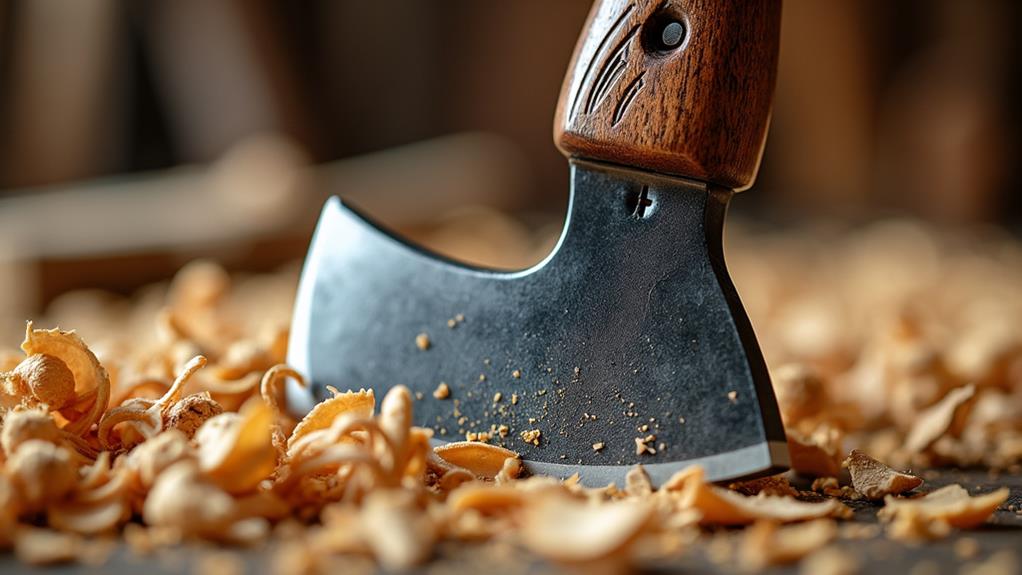
When selecting the best axe for carving and whittling, consider several key factors to ensure you get the right tool for the job. Weight is crucial for balance, while handle length affects control and precision. The edge geometry, including a well-designed bevel, can significantly enhance your woodwork.
Understanding proper maintenance and sharpening techniques is also essential. Prioritize features like a sharp, durable blade, ergonomic handle, and high-quality materials to ensure you're equipped for intricate carving and detailed whittling.
Weight Considerations
When selecting the best axe for carving, considering the weight is crucial. The axe head's weight significantly affects your carving experience. An ideal carving axe typically weighs around 650 grams (1.5 lb). This balance ensures the axe is light enough to prevent fatigue while being substantial enough for efficient chopping.
Choosing a comfortable weight is essential to avoid wrist injuries, especially for smaller users. For them, an axe head weighing between 400-800 grams is optimal. This range is light enough to handle without causing strain but heavy enough for precise and controlled carving. Larger users might find slightly heavier carving axes offer better control, but the weight should still allow for good aim and precision.
Regardless of your size, comfort and the correct weight are key factors for effective carving. They directly impact your control and technique, making your carving sessions both enjoyable and productive. The right weight of the head can significantly enhance your carving experience.
Optimal Size
When selecting the ideal size for a carving axe, consider the handle length, axe head weight, and your comfort. Handles typically range from 30 to 40 cm, providing the necessary control. Axe heads weighing between 400 to 800 grams offer a balanced approach for effective carving. Always consider your strength and preferences to ensure the best fit.
Handle Length Preferences
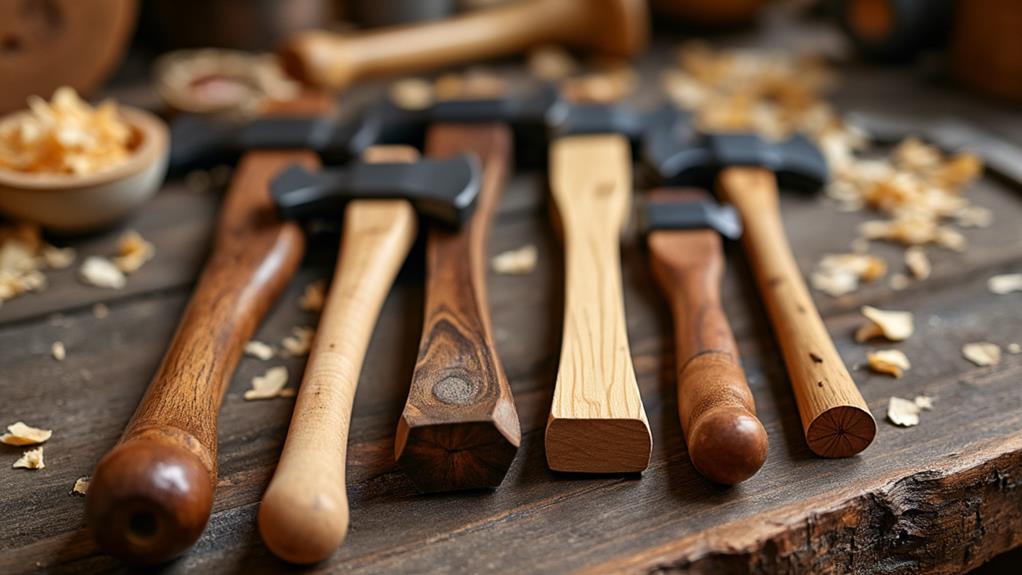
Choosing the right handle length for your carving axe is crucial for achieving both comfort and precision in your work. The handle length significantly influences control and maneuverability. Typically, a suitable handle length ranges from 30 to 40 cm (approximately 12 to 16 inches), offering a good balance for detailed tasks.
Many carvers find that a shorter handle, around 35 cm (approximately 14 inches), provides superior precision for intricate tasks like spoon carving or fine whittling. The shorter handle ensures better control and allows for easy maneuverability without straining your hand. Additionally, it helps reduce fatigue during extended carving sessions, making it an excellent choice for detailed work.
For larger users or those looking to perform more powerful swings, a handle length of 38 to 50 cm (approximately 15 to 20 inches) is often preferred. This length provides improved leverage and control, beneficial for more extensive carving projects.
Ergonomic factors are also important when selecting your carving axe. A well-balanced axe with a comfortable handle can greatly enhance your carving experience, ensuring your work is both efficient and enjoyable.
Axe Head Weight
Selecting the appropriate axe head weight is crucial for achieving precision and control in your carving projects. The ideal weight for a carving axe head typically ranges between 400-800 grams (0.88-1.76 lbs). This range ensures the balance needed for intricate carving tasks without unnecessary strain. An axe head around 650 grams (1.5 lbs) is particularly popular as it balances lightness to reduce fatigue and heft for effective chopping.
When choosing your carving tools, remember that the weight of the axe head significantly affects your ability to maintain precision and control. A lighter axe head allows for more delicate and precise work, essential for detailed carving. However, if the axe is too light, you may struggle with tougher wood.
Conversely, a heavier axe head can make chopping easier but may lead to quicker fatigue and potential wrist injuries, especially for smaller users. Larger users might prefer heavier axes, but it's important to find a weight that allows for good aim and control regardless of your size.
Ultimately, the right weight ensures you can carve efficiently and safely.
Personal Comfort Criteria
Choosing the right axe for carving hinges on personal comfort, with size and weight playing crucial roles. Evaluating the axe handle length is essential, as it directly impacts control and precision. Typically, a handle length ranging from 30-40 cm offers a good balance between maneuverability and control, facilitating detailed work.
Weight is another key factor for comfort and performance. An ideal carving axe should weigh around 650 grams (1.5 lb) to minimize fatigue while still being effective for chopping. The axe head should weigh between 400-800 grams to ensure usability without sacrificing performance.
Personal preferences vary, and what feels right in someone else's hands may not work for you. Larger users might prefer heavier axes for better control, while smaller users might opt for lighter options to maintain good aim.
Ultimately, finding an axe that feels comfortable in your hand is vital. Your personal preferences greatly impact usability and performance. Take your time to try different sizes and weights to choose the one that fits you best for effective and enjoyable carving.
Edge Geometry
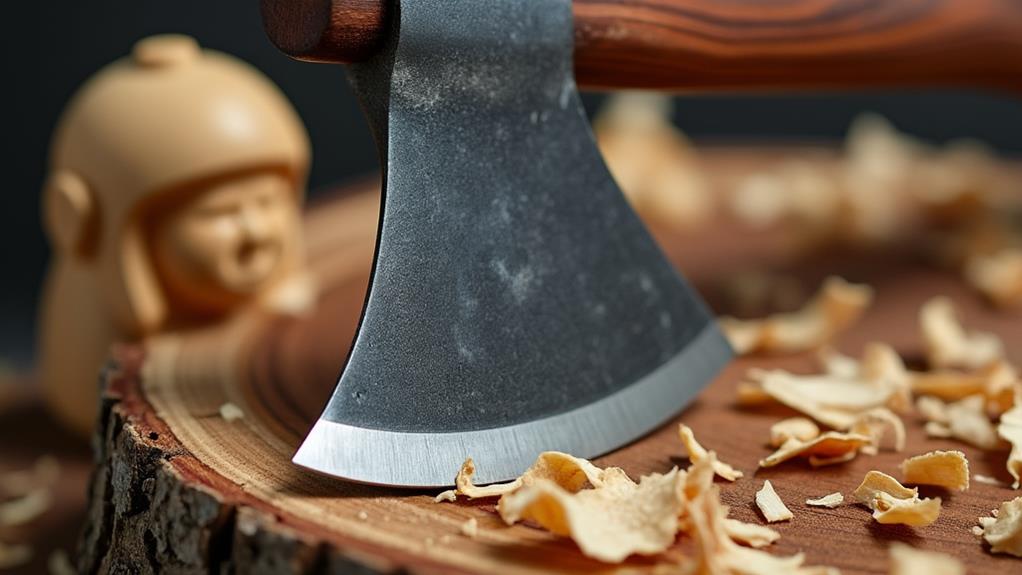
When selecting a carving axe, prioritize edge geometry, particularly the benefits of flat bevels. These wide, flat bevels, usually around 9-10 mm, provide superior wood engagement and control compared to standard convex edges. Ensure your bevels are symmetrical for precise, smooth cuts, enhancing your carving accuracy.
Flat Bevel Advantages
A flat bevel on an axe offers significant advantages for carving due to its edge geometry. When you use flat bevels on a carving hatchet, you gain better wood engagement, which enhances precision and control. This edge geometry allows for a more efficient slicing action, cutting wood fibers smoothly.
You'll find that a flat bevel lets the axe glide effortlessly along the wood surface, simplifying your carving tasks. The recommended width for carving bevels is about 9-10 mm (approximately ⅜ inch). This width ensures that your axe maintains controlled engagement with the wood grain, enabling precise and smooth cuts.
Symmetrical bevels are crucial; they promote even engagement, reducing the risk of slipping or uneven cuts. To achieve this, you'll need to grind off any convexity, as a truly flat bevel makes all the difference.
Additionally, wider bevels enhance your ability to control the engagement along the grain of the wood. However, it's essential to balance this width to maintain the durability needed for chopping. Proper edge geometry with flat bevels is fundamental for effective carving techniques.
Symmetry and Precision
To achieve the highest level of precision in your carving tasks, ensuring your axe's edge geometry is symmetrical is essential. Carving axes benefit immensely from wide, flat bevels, which facilitate smooth sliding on the wood surface. By grinding off any convexity and creating symmetrical bevels, you enhance precision and control. The edge geometry of your axe directly influences its performance, making it easier to achieve fine details in your carving.
Flat bevels are crucial for optimal wood engagement, contrasting with the bullet-shaped edges designed for splitting wood. A properly ground edge with symmetrical bevels guarantees controlled engagement along the grain, making your carving tasks more efficient. This precision allows you to execute detailed work with greater ease, significantly improving your carving experience.
Key Benefits of Symmetrical Bevels
| Benefit | Description |
|---|---|
| Precision | Enhances control and accuracy in carving tasks. |
| Controlled Engagement | Ensures smooth interaction with the wood grain. |
| Efficiency | Boosts overall performance and detail execution. |
Bevel Width Recommendations
Building on the significance of symmetry and precision, let's investigate the ideal bevel width for carving axes. For effective carving, a bevel width of 9-10 mm (approximately ⅜ inch) is recommended. This specific width allows you to achieve optimal control and engagement with the wood grain, enhancing the efficiency of your carving hatchets.
Here are a few key points to consider:
- Wider Bevels for Smoother Cuts: A wider bevel width facilitates smoother cuts and improves control, allowing for precise movements along the grain. This is vital for intricate carvings.
- Balance Between Performance and Durability: While wider bevels enhance carving performance, they might reduce the axe's durability for chopping tasks. Striking a balance ensures your axe remains versatile yet specialized.
- Creating Symmetrical Bevels: The initial step involves grinding off any convexity from the blade to create symmetrical bevels. Symmetry in the cutting edge is fundamental for uniform control.
- Use of Permanent Markers: During the grinding process, using permanent markers helps establish the correct angles and guarantees a consistent bevel width. This simple trick can greatly improve the precision of your work.
Widening Bevels
Widening the bevels on your carving axe is crucial for achieving precise control in woodworking projects. Bevels that are typically 9-10 mm wide (⅜ in) enhance your ability to engage with the wood grain more effectively, thereby improving carving precision. This wider bevel allows for better edge geometry and more efficient carving techniques. However, it is important to note that while wider bevels enhance control, they may reduce the axe's chopping durability, necessitating a balanced approach.
Proper grinding techniques are essential when widening bevels. Begin by using a permanent marker to outline the desired bevel width. Initially, focus on removing material quickly to achieve the broader bevel. This should be followed by careful sharpening to fine-tune the edge geometry for optimal carving performance. Well-ground wider bevels enable smoother movements along the wood surface, which is vital for effective carving.
| Step | Description |
|---|---|
| Marking | Outline the desired bevel width with a marker. |
| Grinding | Quickly remove material to widen the bevel. |
| Sharpening | Fine-tune the edge for smooth, precise carving. |
This method ensures that your carving axe maintains a balance between control and durability, optimizing your woodworking results.
Filing Techniques
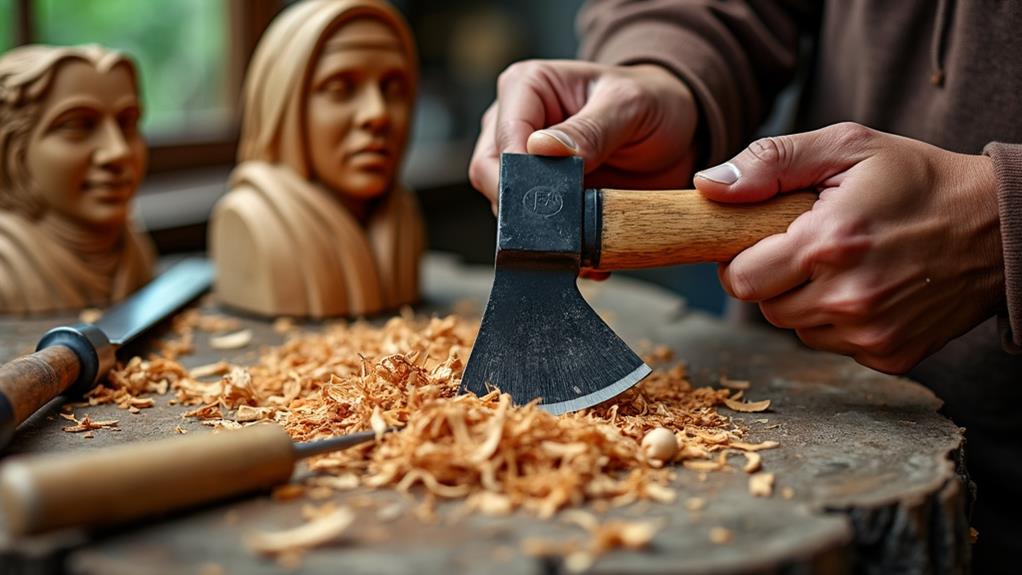
After mastering the art of widening bevels, your next focus should be on refining those edges using effective filing techniques. This step is crucial for ensuring your axe's edge is sharp, precise, and ready for your carving projects.
- Choose the Right Tools: Begin with diamond files or sandpaper. These tools help transition to a flat bevel, ensuring a polished surface that engages better with wood.
- Progression of Grits: Use a series of grits to achieve consistent edge registration and burr formation. This progression enhances the cutting efficiency and sharpness of your axe.
- Maintain Ideal Geometry: Careful filing techniques prevent uneven wear and preserve the axe's optimal geometry, which is fundamental for effective and accurate carving.
- Final Adjustments: If necessary, reshape the handle. A well-shaped handle improves grip and comfort, allowing you to carve for longer periods without fatigue.
Types of Axes
When selecting the best axe for carving, you'll find a range of types tailored to different tasks. Carving axes, like the Gransfors Bruks Swedish Carving Axe and Pfeil Carving Hatchet, are specifically designed for detailed work such as spoon and bowl carving. These axes allow you to achieve the precision and control crucial for intricate designs.
For more general tasks and bushcraft, a hatchet like the Gransfors Bruks Wildlife Hatchet is a versatile choice. It handles both carving and chopping wood efficiently, making it an excellent all-around tool for outdoor activities. Tomahawks also fall into this category, offering flexibility for various tasks.
Side axes, while specialized for certain cuts, mightn't be ideal for intricate carving due to their lack of versatility with concave shapes. However, they can be useful in specific woodworking scenarios.
If you're on a budget, affordable axes priced around $20 can still perform well with proper sharpening. Alternatively, you can find older axes at car boot sales and restore them for effective use.
Different axe head types, such as Jersey, double bit, and forest axes, cater to diverse tasks.
Choosing the right axe for your specific carving needs ensures both efficiency and satisfaction with your work.
Maintenance and Sharpening
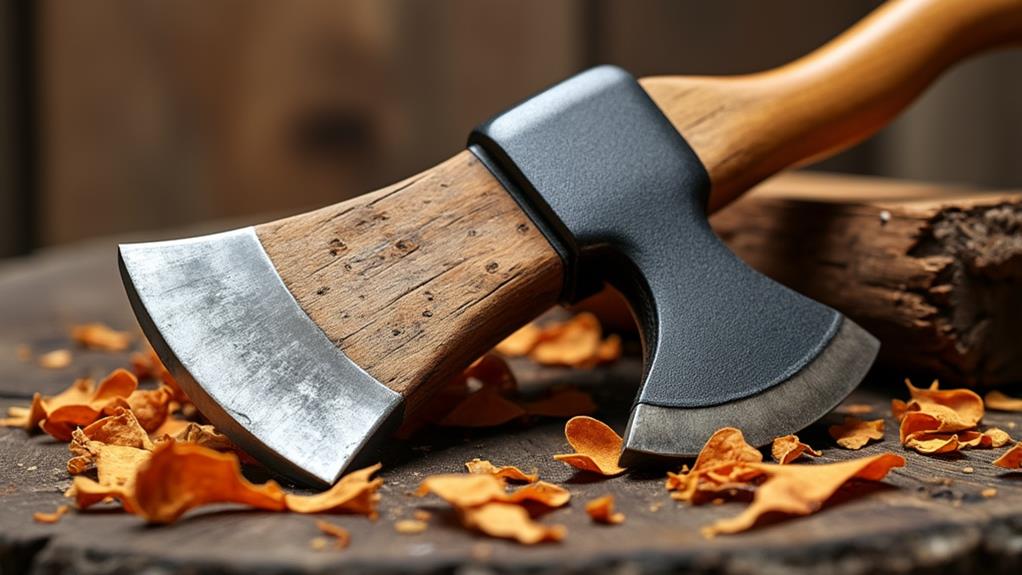
Proper maintenance and sharpening are essential for ensuring your carving axe performs optimally and endures for years. Carving axes often arrive dull, making initial sharpening crucial. Regular maintenance not only keeps the edge sharp but also prolongs the lifespan of your hatchet.
For effective carving, a flat or slightly convex bevel is recommended over the heavily convex edges typical of general-purpose axes.
Follow this guide to maintain your axe:
- Sharpening Method: Utilize diamond files or sandpaper with a gradual grit progression. This technique effectively polishes the carbon steel edge without risking overheating, a common issue with powered grinders.
- Edge Registration: Consistent filing is crucial. Maintain the edge registration to ensure a sharp cutting edge, which involves forming a burr for optimal performance.
- Regular Testing: Frequently test your hatchet's sharpness and make refinements as needed. This ensures it aligns with your carving style and techniques, yielding the best results in your woodworking projects.
- Bevel Shape: Maintain a consistent bevel shape. A flat or slightly convex bevel enhances carving efficiency, unlike the heavily convex edges found on general-purpose axes.
Conclusion
When selecting the best axe for carving and whittling, consider the weight, size, and edge geometry. An axe weighing around 650 grams with a handle length of 30-40 cm provides excellent balance and control. Ensure the axe head falls within the 400-800 grams range and that the bevel width is 9-10 mm. Regular maintenance, including proper filing and sharpening, is crucial to keep your axe in optimal condition. By following these guidelines, you'll choose an axe that enhances your carving experience.