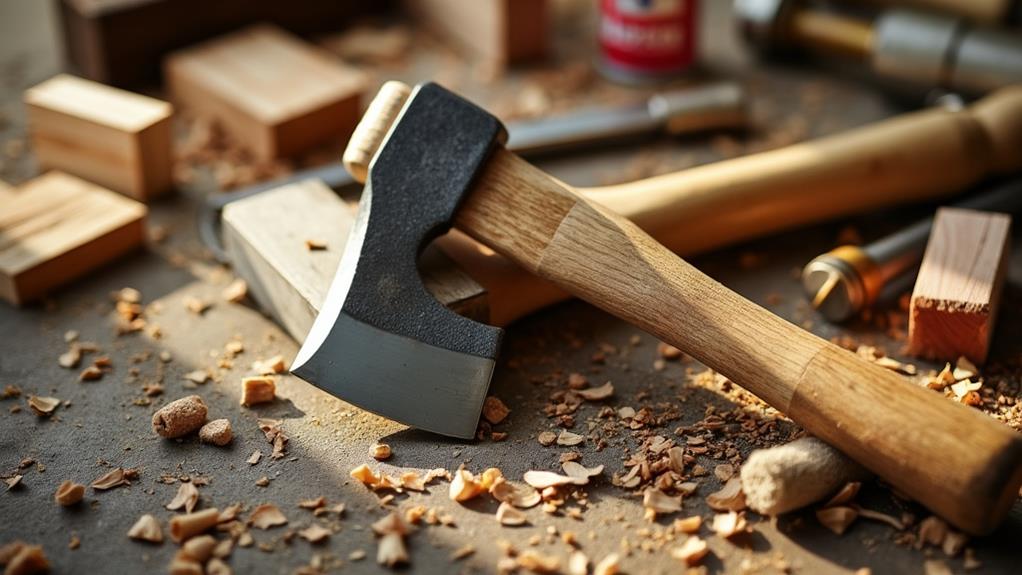
How to Identify Quality Steel in Axe Heads
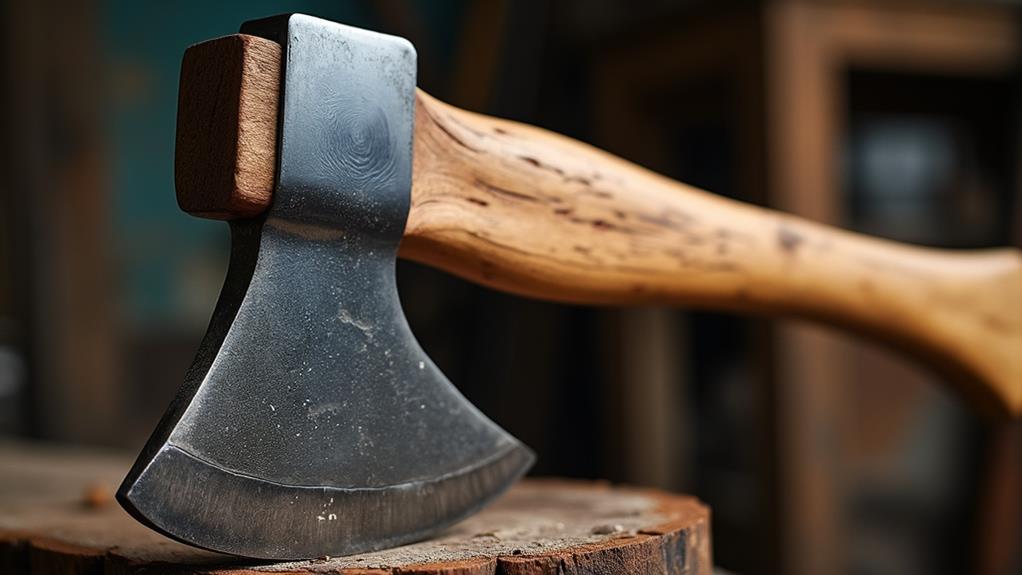
When evaluating the quality of steel in axe heads, start with a visual inspection. Look for manufacturer markings, smooth grind finishes, and overall craftsmanship. High-quality axes often feature a convex grind, minimal pitting, and no visible cracks or seams.
However, visual inspection alone isn't sufficient. To truly assess an axe's durability, you should conduct hardness tests like the Rockwell Hardness Scale or the File Test. Typically, a high-quality axe head falls within the Rockwell hardness range of 45-60 HRC.
For reliable brands, consider those with a reputation for consistent quality, such as Gransfors Bruk, Hults Bruk, and Council Tool.
Visual Quality Indicators
When evaluating the visual quality of an axe head, start by checking for visible manufacturer markings. Reputable brands often use high carbon steel and heat-treated processes, ensuring superior quality. These markings can quickly indicate you're holding a quality axe.
Next, inspect the grind of the axe head. A well-finished axe should have a smooth grind with minimal rough edges, indicating superior craftsmanship and high-quality materials. Quality axes typically feature a convex grind with a high centerline, suggesting better steel and efficient performance during use.
Avoid axes with rough edges or visible seams from forging, as these often signify budget axes made from inferior materials that haven't undergone proper heat treatment. Such deficiencies can affect the axe's durability and performance.
Additionally, examine the axe head for any excessive pitting or deformation. These flaws can compromise the steel's integrity, making the axe less reliable.
Hardness Testing Methods
To accurately assess the hardness of your axe head, you can use the Rockwell Hardness Scale, which measures the resistance of steel to indentation. Ideally, the axe head should score between 56-58 HRC, achieving a balance of durability and sharpness. Alternatively, the Brinell Hardness Test can be used, which involves pressing a hard ball into the steel and measuring the diameter of the resulting indentation.
Rockwell Hardness Scale
Understanding the Rockwell Hardness Scale is crucial for evaluating the quality of steel in axe heads. The scale measures the hardness of metals, expressed in HRC (Rockwell C) values. For high-quality axe heads, the ideal range is 56-58 HRC, balancing hardness and toughness.
To verify an axe head's hardness, you can use several methods:
- File Test: Run a file across the axe head's surface. If the file skates without biting, the steel is likely too hard. If it bites too easily, the steel might be too soft.
- Vinegar Soak: Soak the axe head in vinegar overnight. Hardened steel will show less corrosion compared to softer steel.
- HRC Testing: Use a Rockwell hardness tester for the most precise HRC value, ensuring the steel falls within the ideal 56-58 HRC range.
Brinell Hardness Test
The Brinell Hardness Test is a valuable method for assessing the quality of materials with coarse or uneven structures, such as the cast or forged steels used in axe heads. By pressing a hard steel or carbide ball into the material's surface under a specified load, the test measures hardness based on the indentation left behind.
To calculate the Brinell Hardness (HB) value, use the following formula:
\[ ext{HB} = rac{2P}{\pi D (D - \sqrt{D^2 - d^2})} \]
where:
- \( P \) is the applied load,
- \( D \) is the diameter of the indenter,
- \( d \) is the diameter of the indentation.
For axe heads, a Brinell hardness value ranging between 50 to 60 HB ensures a good balance of hardness and toughness, crucial for effective performance.
Here's a quick reference table:
| Parameter | Symbol | Typical Value for Axe Heads |
|---|---|---|
| Applied Load | \( P \) | Varies |
| Indenter Diameter | \( D \) | Varies |
| Indentation Diameter | \( d \) | Varies |
| Brinell Hardness Value | \( HB \) | 50-60 |
While the Brinell hardness test may not be ideal for very hard materials, it remains an excellent choice for evaluating the quality of carbon steel axe heads.
Manufacturer Markings
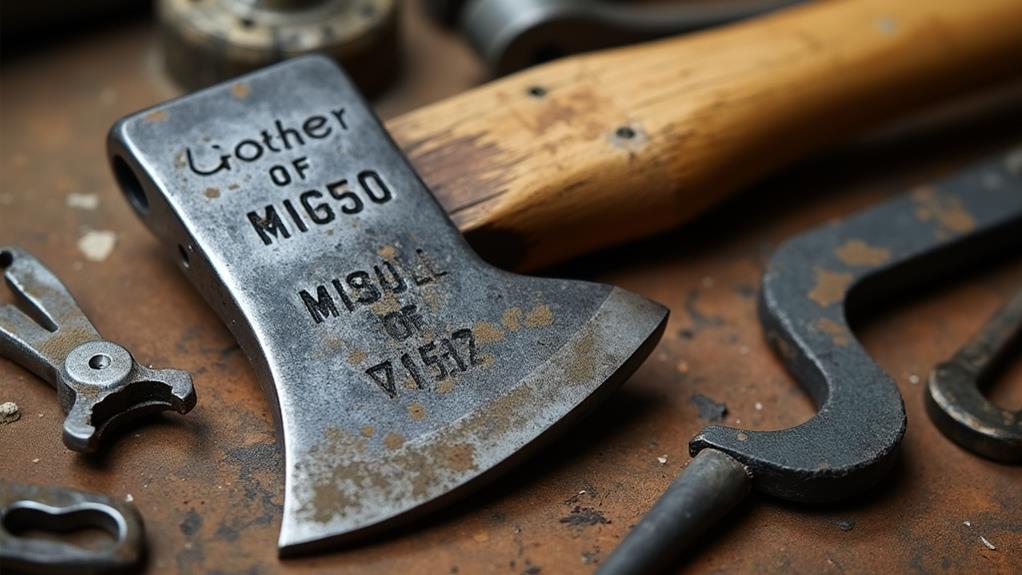
When examining axe heads, manufacturer markings serve as key indicators of quality and craftsmanship. These markings often reveal the brand's reputation and adherence to quality standards. Established makers like Brant & Cochran are renowned for producing heirloom-quality tools, so spotting their markings can assure you of acquiring a high-grade axe head.
To identify these markings, look for visible engravings or stamps on the axe head. These can signify authenticity and the craftsmanship associated with reputable manufacturers. Many quality axe heads feature distinct logos or names that you can research to learn more about the manufacturer's history and materials used.
Knowing where to look for these markings is crucial. Some manufacturers place their engravings near the eye or on the poll, making it easier to identify their products.
Here are three steps to help you identify quality through manufacturer markings:
- Check for visible engravings or stamps: Examine the axe head closely for any logos, names, or symbols.
- Research the manufacturer: Use the markings to investigate the brand's history and quality standards.
- Inspect specific areas: Focus on common marking locations, such as near the eye or on the poll, for easier identification.
Understanding these manufacturer markings enhances your ability to assess the quality and durability of an axe before making a purchase.
Evaluating Grind Types
Analyzing grind types is crucial for determining the quality of steel in axe heads. When examining an axe, prioritize a convex grind with a high centerline. This type often indicates superior steel, providing better cutting performance and durability. Conversely, a hollow grind can signal lower-quality material, as it may weaken the edge and reduce the axe's longevity.
Inspect the grind's finish carefully. A high-quality axe should feature a smooth grind with minimal rough edges, reflecting meticulous manufacturing and superior steel. Excessive wear on the bit thickness may signal poor quality. Quality axes should maintain a robust edge without significant thinning over time.
Consistent grind patterns are another key indicator. Visible irregularities or rough edges suggest inferior craftsmanship and potentially lower-quality steel.
Always take the time to inspect the axe's grind carefully. A high-quality axe will have a uniform grind that enhances its functionality and lifespan. By focusing on these details, you can better determine if the axe is made from quality steel, ensuring you choose a tool that will serve you well for years to come.
Common Defects to Avoid
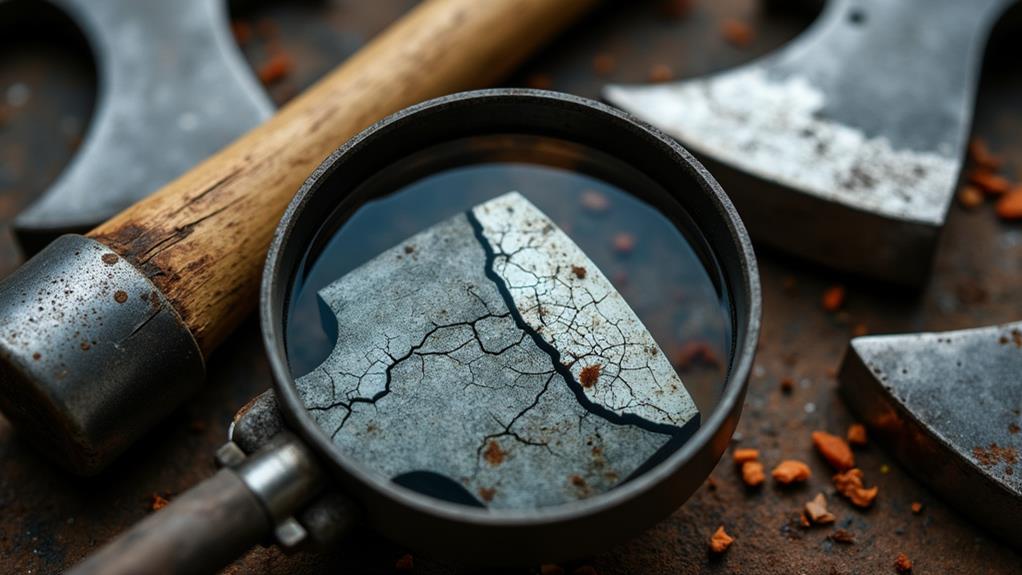
Identifying common defects in axe heads is crucial for selecting a high-quality tool that performs well and lasts long. Here are the key defects to watch out for:
1. Pitting and Deformation: Examine the axe head's surface for excessive pitting or noticeable deformation.
These defects can indicate poor steel quality and potential structural integrity issues, suggesting the axe may not withstand heavy use.
2. Cracks: Pay close attention to any cracks, especially around the eye or poll.
Cracks severely compromise the axe's strength and safety, making it prone to breaking under stress, which can be dangerous.
3. Rough Edges and Seams: Inspect the forging quality.
Rough edges or visible seams often signify a budget axe made from inferior materials, indicating it may not perform well and could fail when needed most.
Restoration Potential
Evaluating the restoration potential of an axe head can save you time and money, ensuring you invest in a tool that's worth the effort.
- Start by examining the axe head for minimal signs of wear. If the heel or toe is excessively rounded, it's best to move on, as these issues significantly diminish the head's restoration potential.
- Next, inspect the axe head for any visible cracks. Cracks compromise the structural integrity, making successful restoration unfeasible.
- Prioritize axe heads with a well-finished surface and smooth grind; these features often indicate quality steel, essential for a durable and effective restoration.
When reviewing potential purchases, be cautious of axe heads with rough edges and noticeable seams from the forging process. These imperfections usually indicate a budget axe, likely made from inferior materials, which limits the restoration potential. In such cases, the effort and resources required may not justify the results.
Expert Recommendations
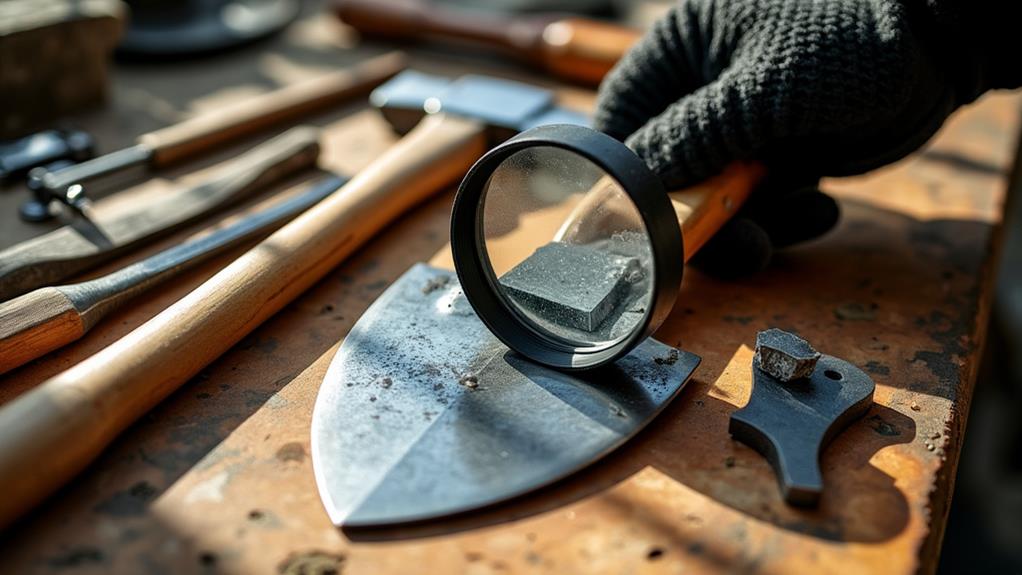
When seeking advice on axe selection, trust experienced craftsmen who prioritize steel composition. Experts often recommend high-quality steels like 1050 or 5160 for their durability and edge retention. Their insights can help you make an informed choice and avoid lower-grade materials.
Trust Experienced Craftsmen
Trusting experienced craftsmen can significantly enhance your ability to identify quality steel in axe heads. These experts possess extensive knowledge about the various types of steel and heat-treating processes that result in durable and efficient tools.
Engaging with seasoned blacksmiths, for example, can reveal why 1050 medium carbon steel is often favored for its balance of hardness and toughness. Properly heat-treated steel will withstand rigorous use without chipping or cracking.
Here's how you can benefit from their expertise:
- Material Recommendations: Craftsmen can suggest the best steel for your needs, ensuring the axe head's material aligns with its intended use.
- Practical Testing Techniques: They can teach you simple tests, such as running a file across the axe head, to gauge its hardness and quality before purchasing.
- Community Knowledge: Participate in workshops and discussions led by experienced axe users to deepen your understanding of steel quality indicators and restoration techniques.
Prioritize Steel Composition
To ensure you're getting a high-quality axe head, it's essential to prioritize steel composition based on expert guidelines. Carbon content in the steel significantly affects the axe's performance, durability, and edge retention. Here's a concise guide to help you make informed decisions:
| Steel Type | Carbon Content | Key Characteristics |
|---|---|---|
| 1050 | 0.5% | Well-balanced hardness and durability |
| 5150 & 5160 | 0.5-0.6% | Enhanced edge retention and toughness |
| 1075-1095 | 0.75-0.95% | Easy to forge and heat treat |
| 4140 & O1 | 0.4% & 0.9% | Performance varies with precise heat treatment |
The most frequently recommended steel for high-quality axe heads is 1050 medium carbon steel. Its balanced carbon content of 0.5% and trace elements provide a good mix of hardness and durability. For superior edge retention and toughness, consider 5150 or 5160 carbon steels. If ease of forging and heat treatment is a priority, the 10XX series, particularly 1075-1095, are excellent choices.
Higher alloyed steels like 4140 and O1 can be used but require precise heat treatment for optimal performance. While stainless steels such as 420HC offer corrosion resistance, they may require more frequent sharpening compared to carbon steels. Prioritizing the right steel composition ensures long-lasting performance and reliability.
Market Trends and Sources
The landscape of quality axe heads is often shaped by market demand, so patience during your search can be rewarding. Understanding market trends will help you identify where and when to find quality axe heads.
For instance, vintage axes are increasingly popular due to their superior craftsmanship and materials, driving up their prices. By paying attention to these trends, you can better anticipate the availability and pricing of high-quality options.
Connecting with reputable manufacturers is crucial. They often set the standards for quality axe heads and can be a reliable source for your purchases. Knowing which brands are trusted in the industry will make your search more efficient and fruitful.
To optimize your chances of finding quality axe heads, consider these strategies:
- Attend Local Axe Shows or Markets: These events allow you to handle axes firsthand and network with knowledgeable vendors and enthusiasts.
- Research Online Forums and Community Discussions: These platforms provide valuable insights into current market trends and recommendations for reputable sources.
- Study Reputable Manufacturers: Familiarize yourself with top brands known for producing high-quality axe heads to ensure you're buying from trustworthy sources.
Conclusion
To ensure you're getting a quality axe head, focus on visual indicators such as manufacturer markings, a smooth grind, and overall finish. Conduct hardness tests to confirm durability, aiming for 56-58 HRC. Prioritize reputable brands and high-quality steels like 1050 or 5160. Be vigilant for defects such as pitting or cracks. By following these guidelines, you'll make informed choices and find an axe head that offers peak performance and longevity.