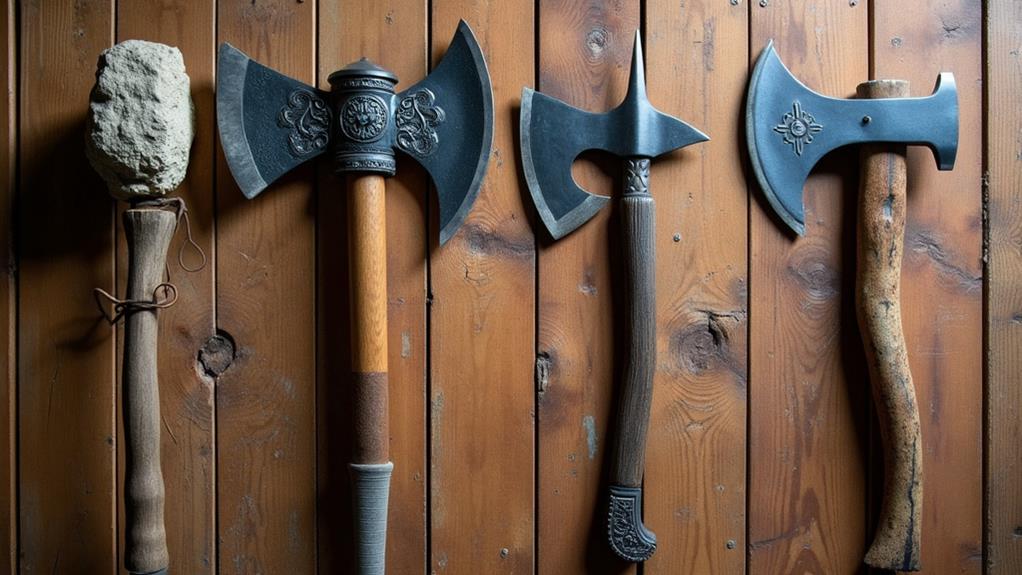
History of the Double-Bit Axe
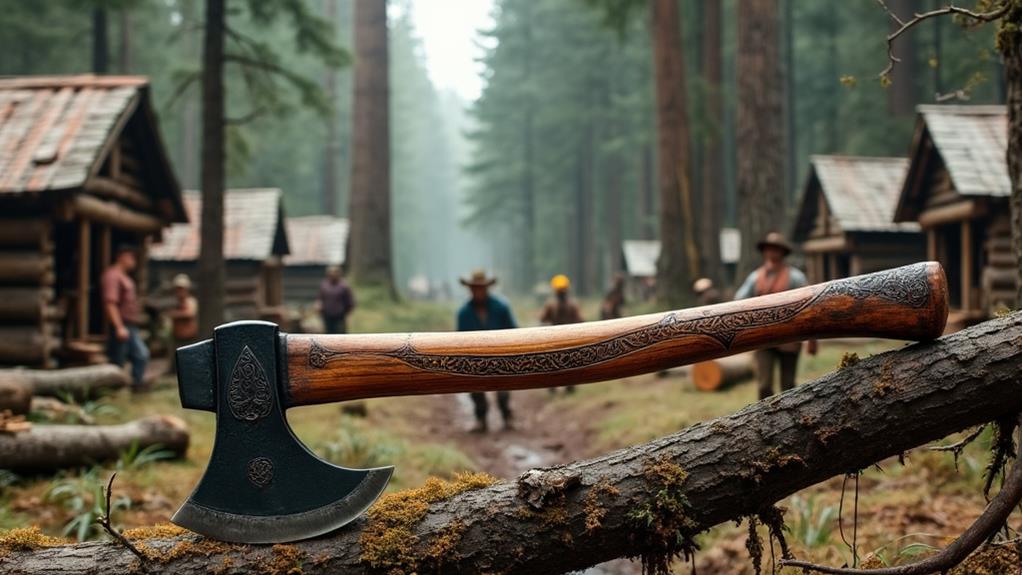
The double-bit axe has a rich history that traces back to ancient civilizations. Originally known as the "labrys" in Minoan culture, this tool was not only used for chopping wood but also held significant ceremonial importance.
As metalworking techniques advanced, the axe evolved from a simple hammered tool to one crafted using sophisticated casting methods. This transformation shaped its role in various societies and established it as a symbol of efficiency in both Europe and America.
Let's explore the fascinating journey of the double-bit axe.
Ancient Origins
Although the double-bit axe is often associated with practical uses today, its origins trace back to the Stone Age where it served more ceremonial purposes. In ancient cultures, particularly in Greece, the double-bit axe, known as the "labrys," symbolized duality and played a significant role in rituals and agricultural fertility practices. These axes weren't just tools; they were powerful symbols representing the cycles of life, creation, and destruction.
Archaeological evidence suggests that double-bit axes were integral to ancient ceremonies. For instance, they were used in symbolic acts such as vine cutting to promote agricultural health and prosperity. This practice highlighted the interconnectedness between humans and the natural world. The act of cutting vines with a double-bit axe was believed to guarantee a bountiful harvest, reinforcing the axe's role in agrarian rituals.
Historical artifacts further underscore the significance of the double-bit axe in ancient culture. Clay models of double-bit axes, often adorned with gold, have been unearthed, exemplifying their ceremonial importance.
These artifacts reveal that the double-bit axe wasn't merely a functional tool but a profound symbol in ancient societies.
Minoan Innovations
Around 2500 BCE, the Minoan civilization made significant advancements with the double-bit axe, transitioning it from a ceremonial object symbolizing power and status to a practical tool. Initially, these axes served primarily as votive objects within Minoan society.
Minoan craftsmen advanced from basic hammering and riveting techniques to more sophisticated casting methods. This evolution in manufacturing allowed for greater durability and uniformity, improving the cutting efficiency of the double-bit axes with their two sharp blades. These innovations not only enhanced functionality but also demonstrated the Minoans' technological expertise.
In Minoan culture, the double-bit axe held profound symbolic meanings and was often linked to sacred rituals. These axes were frequently found in burial sites, signifying their spiritual importance and the high status of the individuals interred with them.
The design and utility of these axes influenced later civilizations in the Aegean region, cementing the Minoans' legacy in tool-making. These artifacts illustrate the close relationship between daily life and spiritual beliefs in Minoan society, showcasing their remarkable advancements in both technology and culture.
Early Manufacturing Techniques
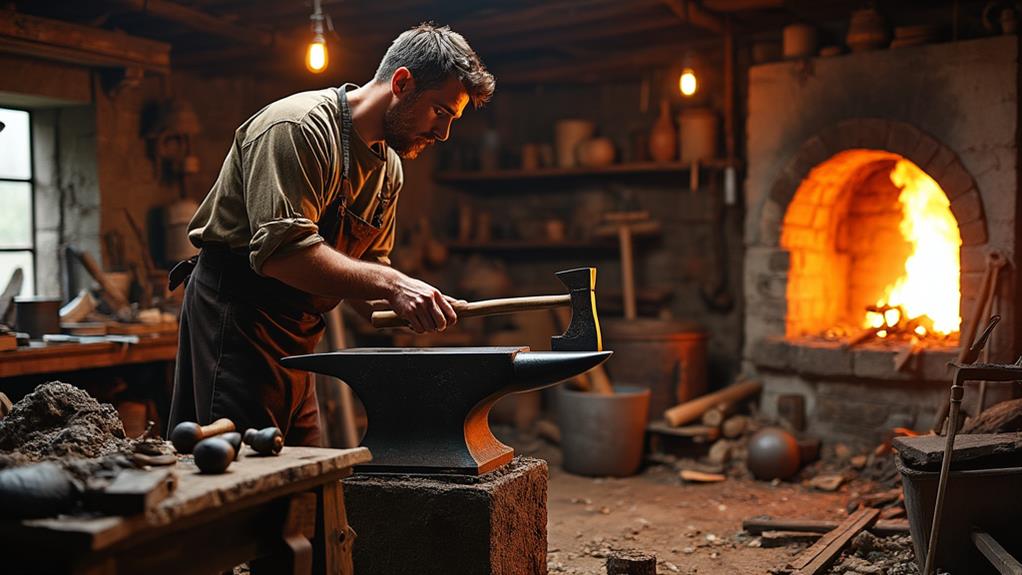
The early manufacturing techniques of double-bit axes were rooted in the meticulous craftsmanship of Minoan artisans around 2500 BCE. Initially, they hammered and riveted bronze plates to create these axes as votive objects. Over time, these ceremonial items transitioned into functional tools, marking a significant technological advancement. This shift was facilitated by the advent of casting techniques, which enabled the production of more durable and efficient double-bit axes.
Skilled artisans were pivotal in this evolution, utilizing molds to ensure uniformity and consistency in each axe's design. The double-bit design, featuring two blades, greatly improved cutting efficiency and versatility, making these axes indispensable for various tasks. The use of bronze alloys further enhanced the strength and longevity of these tools, reflecting the sophisticated metalworking practices of the period.
Consider the following table that captures the essence of early manufacturing techniques of the double-bit axe:
| Technique | Purpose | Emotional Impact |
|---|---|---|
| Hammering & Riveting | Initial creation | Appreciation for artistry |
| Casting | Durability | Awe at technological advancements |
| Use of Molds | Uniformity | Respect for precision |
| Double-Blade Design | Efficiency | Admiration for ingenuity |
| Bronze Alloy | Strength | Fascination with skill |
Exploring these techniques provides a deeper appreciation for the craftsmanship behind the double-bit axe.
Symbolism in Ancient Cultures
In ancient cultures, the double-bit axe, or "Labrys," symbolized profound themes of power and fertility. This was particularly evident in Minoan culture, where the axe wasn't merely a tool but a sacred symbol deeply embedded in their rituals.
At the temple of Knossos on Crete, the double-bit axe represented the dual aspects of life: creation and destruction. Central to rituals involving bull sacrifices, it highlighted its connection to agricultural fertility and the cyclical nature of life.
Women wielding the double-bit axe during vine-cutting ceremonies underscored their crucial role in agricultural prosperity. These ceremonies were significant cultural events that emphasized the importance of women's contributions to society's sustenance and growth.
Thus, the double-bit axe became a symbol of female power and the life-giving force of nature.
Across various ancient cultures, the double-bit axe embodied themes of life, death, and rebirth. Its historical significance transcended practical use, evolving into a powerful cultural artifact that reflected societal values and spiritual beliefs.
Understanding the symbolism of the double-bit axe provides insight into the complex spiritual and cultural dynamics of these ancient civilizations.
Evolution in Ancient Greece
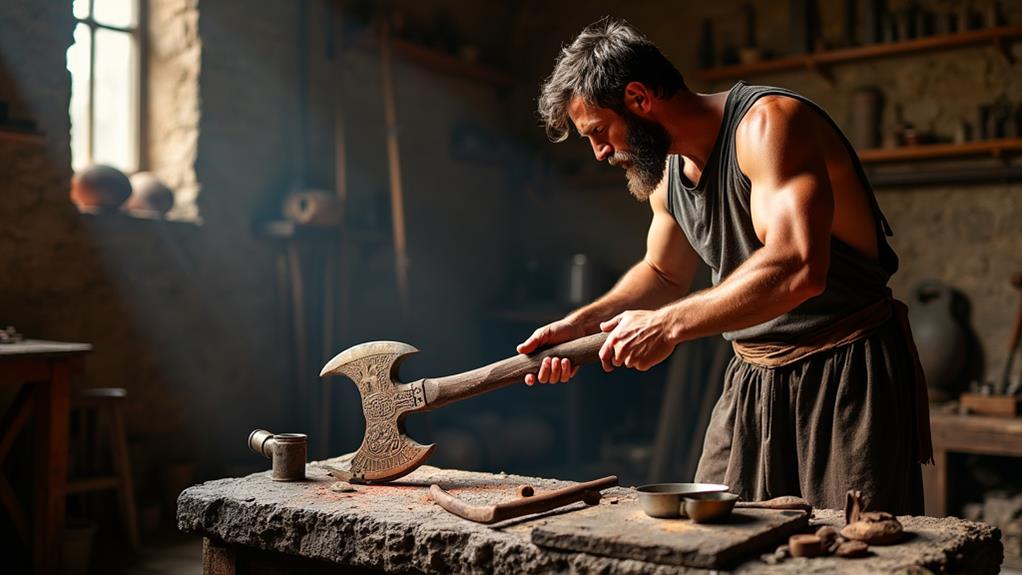
In Ancient Greece, the double-bit axe, known as "labrys," played a crucial role in rituals and ceremonies, particularly at the temple of Knossos. This tool was more than a practical implement; it symbolized fertility, agricultural prosperity, and the duality of life and death. Additionally, it represented women's power, making it a significant cultural artifact intertwined with both spiritual and everyday life.
Ritualistic Ceremonial Uses
In ancient Greece, the double-bit axe known as the "Labrys" was more than a mere tool; it was a potent symbol deeply embedded in ritualistic and ceremonial traditions. At the temple of Knossos on Crete, the Labrys symbolized both power and ritual significance. During annual rites, young men and women entered the labyrinth to participate in symbolic acts of personal growth, culminating in bull sacrifices. These rituals were profound, reflecting the cyclical themes of life, death, and rebirth.
The Labrys also played a crucial role in ceremonies involving the cutting of vines, linking the act to agricultural fertility and prosperity—vital aspects of this agrarian society. Its dual blades symbolized the balance between creation and destruction, a balance emphasized in Minoan ceremonies that highlighted the cyclical nature of life.
Furthermore, the double-bit axe had a strong association with feminine power. Its use in fertility rites underscored the connection between women's influence and agricultural abundance. By wielding the Labrys, participants in these rituals highlighted the essential relationship between human effort and nature's bounty.
Symbol of Fertility
Frequently revered in ancient Greece, the double-bit axe, or "Labrys," became an enduring symbol of fertility. Deeply intertwined with the temple of Knossos on Crete, it played a vital role in fertility rituals. The Labrys was used to cut vines, a practice believed to promote agricultural prosperity and embody growth and renewal.
In these annual ceremonies, young men and women actively participated in symbolic acts that mirrored the life cycle, from birth to death. The dual nature of the Labrys, with its two sharp blades, beautifully represents the balance between creation and destruction, reflecting the cyclical nature of life in Minoan culture.
Key aspects include:
- The Labrys as a powerful emblem of women's roles in society, emphasizing their importance in agricultural practices and fertility rites.
- Cutting vines with the axe was seen as a way to encourage bountiful harvests.
- The axe's association with the temple of Knossos highlights its spiritual significance.
- The participation of young people in rituals underscored the continuity of life and the transfer of cultural values.
Embracing the Labrys in these ways, ancient Greeks celebrated and revered the life-giving forces that sustained their communities.
Cultural Duality Significance
The double-bit axe, or "Labrys," was more than a symbol of fertility; it embodied the profound concept of duality in ancient Greek culture. Rooted in Minoan traditions, this iconic tool played a crucial role in the temple of Knossos on Crete, signifying its importance in diverse rituals and ceremonies.
In ancient Greece, the Labrys symbolized duality, representing the balance between creation and destruction. This duality was evident in agricultural fertility rites and spiritual practices. For instance, vine-cutting ceremonies with the double-bit axe were believed to promote agricultural growth and prosperity, highlighting the cyclical nature of life.
The Labrys's design and use in Minoan rituals underscored its significance as a status symbol, reflecting societal power dynamics. It wasn't just a tool but a profound emblem connecting everyday life with spiritual beliefs.
The enduring cultural significance of the double-bit axe through various Greek traditions reinforced its role in linking human experiences with the divine and the natural world. Understanding the Labrys's duality offers insight into the ancient Greeks' worldview, where every aspect of life was interconnected.
Ritualistic Uses
The double-bit axe, known as "Labrys," played a significant role in ancient Greek rituals, symbolizing power and fertility. In the temple of Knossos, it was central to many ceremonies. Annual rituals often included using the axe to cut vines, symbolizing growth and fertility.
More than just a tool, the double-bit axe was a powerful symbol in bull sacrifices, crucial to Minoan rituals. This association highlights its role in connecting agriculture, life, and death within the community. The axe represented duality, embodying both creation and destruction, making it a sacred object in cultural practices.
Archaeological findings reveal that double-bit axes were often placed in tombs, underscoring their significance in burial rites and their role in the transition between life and death.
Key ritualistic uses of the double-bit axe include:
- Annual fertility ceremonies: Symbolizing growth by cutting vines.
- Bull sacrifices: Reflecting agricultural and life-death connections.
- Embodiment of duality: Representing creation and destruction.
- Burial practices: Sacred objects marking the transition from life to death.
Understanding these uses offers a deeper appreciation for the double-bit axe in ancient rituals.
Spread to Europe
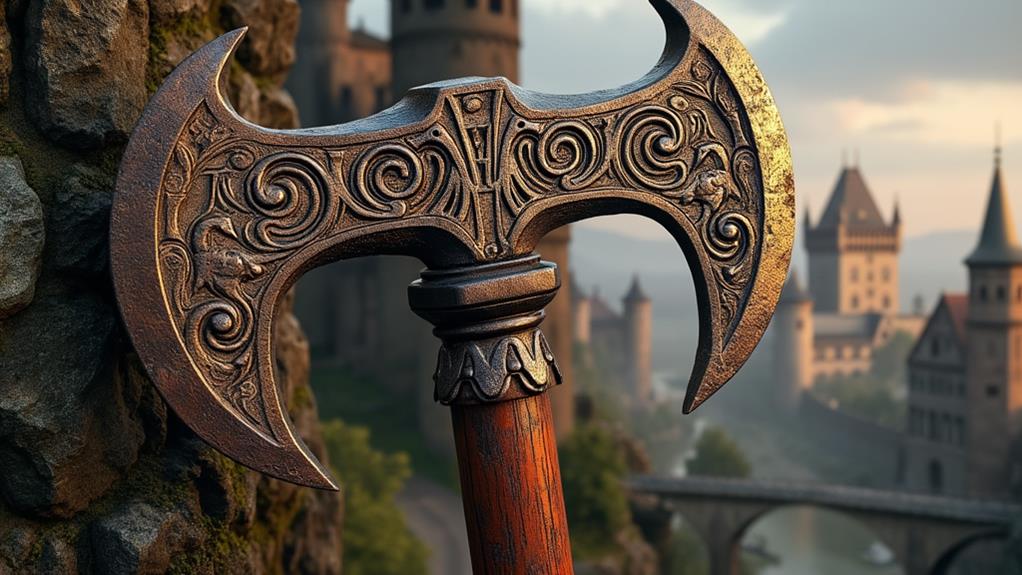
Initially developed in North America, the double-bit axe gained traction in Europe during the late 19th and early 20th centuries as lumbering practices evolved and the demand for efficient wood-cutting tools grew. European craftsmen were initially skeptical, favoring their traditional single-bit axes. However, the adaptability and efficiency of the double-bit axe eventually led to its widespread adoption.
The spread of the double-bit axe in Europe coincided with the rise of forestry industries, particularly in countries like Sweden and Finland. Its effectiveness in felling and splitting wood was quickly recognized, resulting in its integration into European axe-making traditions and the emergence of unique regional designs tailored for specific logging needs.
| Country | Key Feature |
|---|---|
| Sweden | Effective in dense forests |
| Finland | Adaptation to varying terrain |
| Germany | Sturdy craftsmanship |
| Norway | Precision in wood splitting |
| France | Blending traditional designs |
The cultural significance of the double-bit axe in Europe was underscored through its representation in folklore and craftsmanship. This mirrored its symbolic role in American lumberjack mythology, cementing its place not just as a tool but as a cultural icon. Thus, while it originated in North America, the double-bit axe became an integral part of Europe's logging heritage.
American Advancements
During the American Colonial Period, the double-bit axe underwent significant transformation, becoming essential for the growing lumber industry. American craftsmen diverged from European designs, creating a balanced and functional tool suited to local demands. This innovation not only enhanced efficiency but also symbolized resilience in American folklore and industry.
Colonial Era Innovations
During the Colonial Era, American innovation in tool-making took a significant leap forward with the introduction of the double-bit axe. Unlike European axes with a single blade, the double-bit axe featured two sharp edges, making it a game-changer in various applications.
American craftsmen led this innovation by experimenting with designs, leading to a symmetrical axe that improved both balance and cutting efficiency. The double-bit axe became particularly favored for several reasons:
- Versatility: Its dual blades allowed for continuous work without frequent sharpening.
- Balance: The symmetrical design improved control and reduced fatigue.
- Efficiency: It was highly effective in chopping and splitting wood, crucial for the booming Northern lumber industry.
- Cultural Icon: Figures like Paul Bunyan helped popularize the axe, embedding it in American folklore.
This tool wasn't just a practical innovation; it became a cultural emblem of the American spirit. The double-bit axe marked a notable advancement in tool-making, reflecting the resourcefulness and adaptability of American craftsmen during that period.
Lumbering Industry Evolution
The double-bit axe, which emerged during the Colonial Period, rapidly became essential in the evolving American lumbering industry. By the Civil War, advancements in tool-making techniques had cemented its importance for lumberjacks. American craftsmen's continuous experimentation resulted in the creation of the double-bit axe, celebrated for its balance and cutting efficiency.
| Feature | Benefit |
|---|---|
| Symmetrical Design | Multifunctional use in chopping and splitting |
| Balance | Enhanced control and precision |
| Cutting Efficiency | Faster processing of diverse wood types |
| Cultural Symbol | Represented by Paul Bunyan |
| Economic Impact | Boosted growth of Northern states |
The symmetrical design of the double-bit axe allowed lumberjacks to easily switch between chopping and splitting, making it highly versatile for various types of wood. This versatility was pivotal for the lumbering industry, enabling more efficient processing of timber. By the late 19th century, the double-bit axe was widely recognized for its role in transforming forests into farmlands, significantly contributing to the economic growth of Northern states.
The cultural figure of Paul Bunyan symbolizes the indispensable role of the double-bit axe in American forestry and labor. This tool was not just an implement but became an emblem of the era's industrious spirit and ingenuity, reinforcing its lasting legacy in the lumbering industry.
Design and Functionality
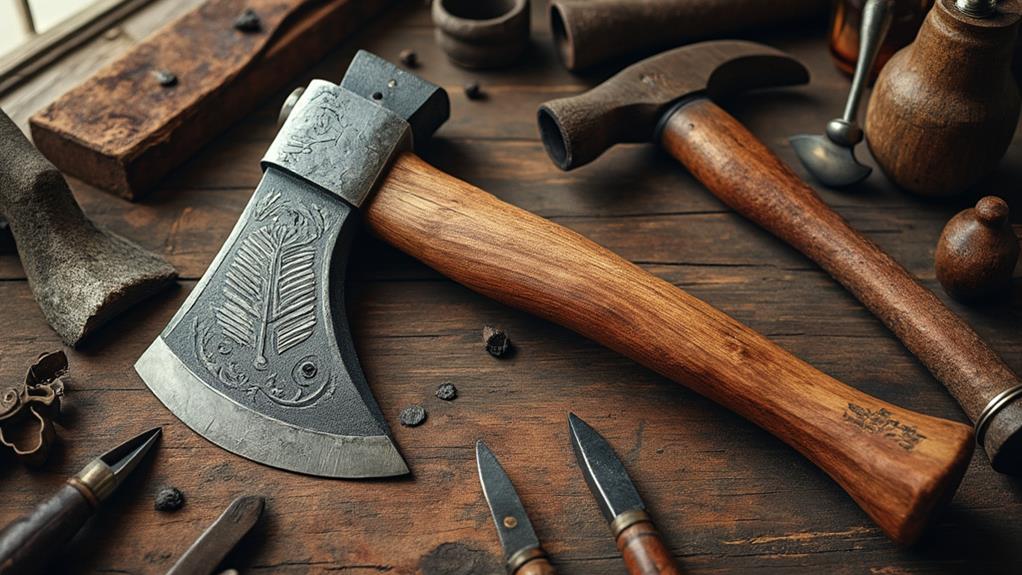
Despite its simple appearance, the double-bit axe is meticulously designed for optimal efficiency and versatility. It features a symmetrical structure with broad blades on either side, enabling a range of chopping and splitting tasks with ease. Each blade is sharpened to minimize bounce back, ensuring continuous work without frequent resharpening.
To fully appreciate the double-bit axe's design and functionality, consider the following key points:
- Symmetry: The symmetrical design across all axes enhances balance, making the axe easier to control and more effective in use.
- Dual Edges: One edge can be maintained razor-sharp for precise cuts, while the other is suited for more demanding, rougher jobs.
- Weight and Balance: The weight distribution behind the blades is carefully calibrated to optimize both sharpness and durability, significantly affecting overall performance.
- User Comfort: Proper swinging technique and handling are crucial, as individual comfort directly impacts the axe's effectiveness.
When using a double-bit axe, your technique and comfort play critical roles in its performance. By maintaining one sharp edge and one for rougher tasks, you ensure your tool remains versatile and ready for any challenge.
Modern Relevance
The double-bit axe remains a favorite among outdoor enthusiasts for its efficiency and versatility. Modern manufacturers like Gränsfors Bruk and Council Tool continue to craft these axes, blending traditional techniques with contemporary designs. Educational programs highlight their historical significance and practical applications, ensuring they remain relevant today.
Contemporary Axe Designs
Modern double-bit axe designs have advanced significantly, blending historical craftsmanship with contemporary technology. Today's axes benefit from improved metallurgy and ergonomic features, ensuring enhanced performance and user comfort. Brands like Gränsfors Bruk and Council Tool have become synonymous with high-quality double-bit axes, emphasizing durability and precision.
These modern tools cater to both traditionalists and outdoor enthusiasts, reflecting a deep appreciation for their historical roots.
Key features of modern double-bit axes include:
- Lightweight materials to reduce user fatigue
- Balanced designs for improved control and precision
- Enhanced durability through advanced metallurgical techniques
- Ergonomic handles for increased comfort during prolonged use
The cultural significance of the double-bit axe remains robust, symbolizing craftsmanship and strength. Educational programs and workshops focused on axe-making and usage aim to preserve historical techniques while promoting modern advancements.
Whether you're a seasoned woodworker or a novice, the double-bit axe continues to hold a special place in both practical applications and as a collectible item. For more detailed guides and tutorials, specialized websites dedicated to this timeless tool often require registration or login.
Outdoor Enthusiast Appeal
If you're passionate about the great outdoors, the double-bit axe is an indispensable tool that blends utility with tradition. For outdoor enthusiasts, its versatility is unmatched. With two sharp edges, you can switch between different cutting tasks without the need for frequent sharpening, allowing you to spend more time enjoying nature and less time maintaining your gear.
Modern manufacturers like Gränsfors Bruk and Council Tool produce high-quality double-bit axes that appeal to traditionalists and those who appreciate fine craftsmanship. The symmetrical design provides improved balance, making it easier to handle and swing. This is particularly beneficial for woodsmen and arborists who need efficient wood processing.
With the growing interest in camping, bushcraft, and homesteading, the double-bit axe has seen a resurgence. It's more than just a tool; it's a symbol of strength and a connection to historical woodworking and forestry practices.
| Feature | Benefit |
|---|---|
| Dual sharp edges | Versatile cutting tasks |
| Symmetrical design | Improved balance and handling |
| Quality craftsmanship | Long-lasting and durable tools |
| Historical legacy | Connection to traditional skills |
| Popular brands | Gränsfors Bruk, Council Tool |
Whether you're splitting logs or clearing a campsite, the double-bit axe remains a favorite among outdoor enthusiasts.
Conclusion
The double-bit axe has a rich history, originating as a ceremonial tool in ancient rituals and evolving through Minoan craftsmanship into a practical implement. Its journey through Greece, Europe, and America underscores its enduring significance and adaptability. Today, the double-bit axe not only symbolizes ancient cultures but also celebrates human ingenuity and industriousness. It remains a timeless tool, embodying both historical significance and practical functionality in modern times.