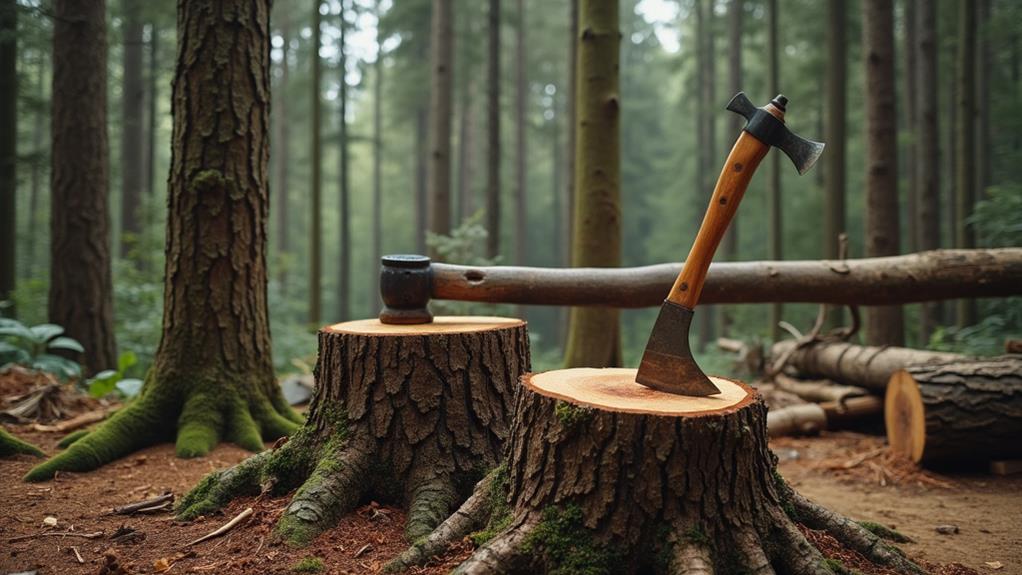
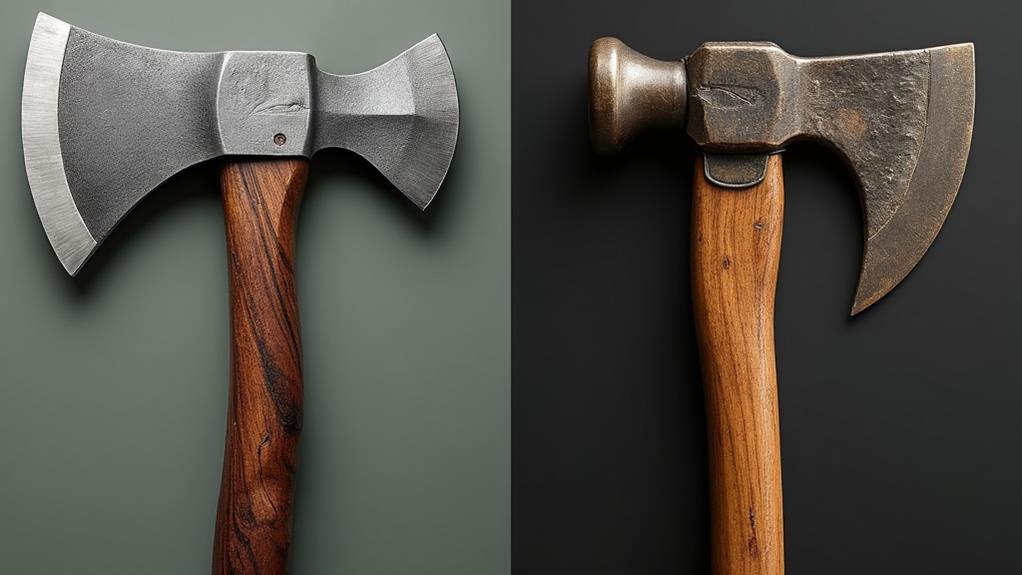
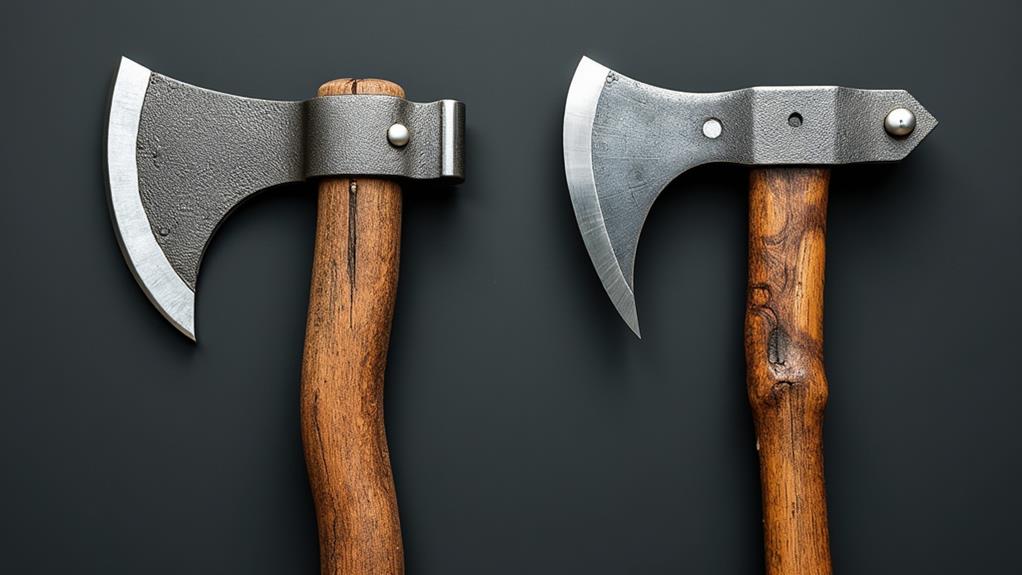
The Role of Axes in Early American Homesteading
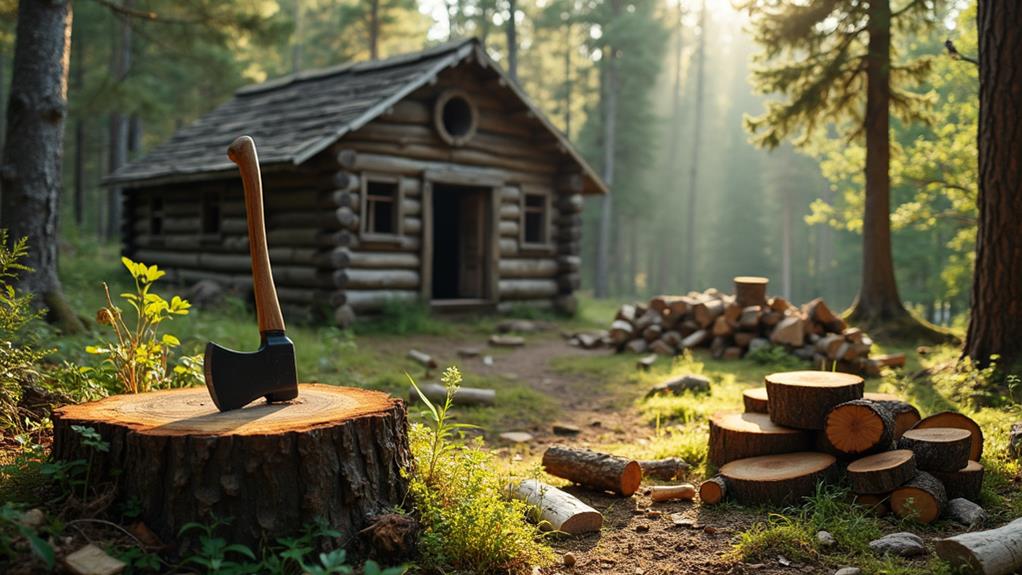
Imagine you're an early American settler, surrounded by dense, uncharted forests. Your survival hinges on a single tool: the axe. This indispensable instrument helps you clear land, build shelters, and prepare fields for crops.
Its design evolves to meet the specific challenges of North America's diverse timber, reflecting a blend of ingenuity and necessity. However, as the wilderness begins to tame and the landscape transforms, the axe's role starts to shift.
How does this evolution impact the homesteading culture that once depended so heavily on it? Let's delve into these questions further.
Historical Significance
In early American homesteading, axes weren't merely tools but essential lifelines. As a settler, you depended on your axe to clear land, construct shelters, and establish an agrarian lifestyle. The dense forests covering the vast American landscape required immense strength and resilience to navigate. By 1900, settlers had cleared approximately 500 million acres of forestland, with felling axes being crucial to this monumental achievement.
The axe symbolized more than utility; it epitomized strength and hard work. Initially crafted from European designs, these tools were adapted to handle North American timber, leading to the development of specialized felling axes suitable for larger trees. This craftsmanship not only enhanced efficiency but also fostered a profound connection between settlers and the natural environment.
For a homesteader, the axe was an extension of oneself, embodying the skills and traditional woodwork essential for survival. It signified the cultural importance of craftsmanship, playing a vital role in taming the wilderness and shaping the American frontier.
Without it, the success of early American settlers would have been unimaginable.
Evolution of Axe Design
Early American settlers adapted European axe designs to better handle North America's larger timber, leading to the creation of tools like the modern felling axe. By the 19th century, regional variations emerged, with over 300 distinct head patterns tailored to local woods and specific tasks. Technological advancements, such as the double-bit axe, demonstrated the ongoing refinement and specialization driven by the diverse needs of homesteaders and loggers.
Trade and Adaptation
The evolution of axe design in early American homesteading illustrates human ingenuity and adaptability. Settlers initially brought European axes to North America, but these tools proved unsuitable for the towering trees they faced. To address this, settlers made crucial adaptations, such as shortening the blades to create more efficient felling axes with heavier polls and shorter bits, ideal for the massive North American timber.
Trade axes like the Hudson Bay pattern, initially used in the colonial fur trade, were also modified. These early axes became the foundation for locally produced tools tailored to the settlers' unique logging needs. By the 19th century, over 300 different axe head patterns had been manufactured, reflecting the diverse logging practices and toolmaking traditions across North America.
Each region developed specialized axes. For example, the Kentucky pattern was suited for southern hardwoods, while broad axes were used for smoothing surfaces.
These adaptations highlight how settlers ingeniously customized their tools to their environments and tasks. The evolution of axe design not only facilitated the survival of early homesteaders but also exemplified American ingenuity.
Regional Variations
Throughout early America, the evolution of axe design demonstrated settlers' ingenuity in adapting to various environments. Influenced by European models, early American settlers modified these tools to better navigate the dense North American forests. This led to regional variations in axe designs, essential for effective logging practices.
- Kentucky Pattern: In the South, the Kentucky pattern emerged, specifically tailored for the hardwoods prevalent in that region.
- New England Axes: In the North, axes were optimized for cutting pine, reflecting the distinct logging practices and tree species.
- Hudson Bay Trade Axe: This design was intended for trade with Native Americans, blending European influences with local needs.
- Variety of Axe Head Patterns: By the 19th century, there were over 300 distinct axe head patterns, each suited for specific logging environments.
Seasonal logging practices also impacted design innovations. In Michigan, for instance, axes with rounded corners were developed to prevent chipping on frozen wood during winter.
These regional variations in axe designs underscore how settlers continually refined their tools to increase efficiency and address the challenges of their unique environments.
Technological Advancements
Early American settlers constantly innovated to meet the demands of their environment, starting by modifying European axes. They transformed these tools into single-bit felling axes with heavier polls and shorter bits, creating what's now known as the American axe, tailored specifically for North America's larger timber.
By the 19th century, axe makers had developed over 300 unique axe head patterns, each designed for specific regional wood species and logging practices. For example, the Kentucky pattern was ideal for tough southern hardwoods like oak and hickory.
The introduction of the double-bit axe in Pennsylvania between 1840 and 1850 revolutionized logging, offering improved efficiency and versatility. These advancements extended beyond shape and weight to include better materials and construction techniques. While modern chainsaws eventually supplanted axes in the mid-20th century, vintage axes have experienced a resurgence in interest.
Many people now appreciate these high-quality, handmade tools for their historical craftsmanship and contemporary utility. These axes symbolize the ingenuity and adaptability of early American settlers.
Practical Usage
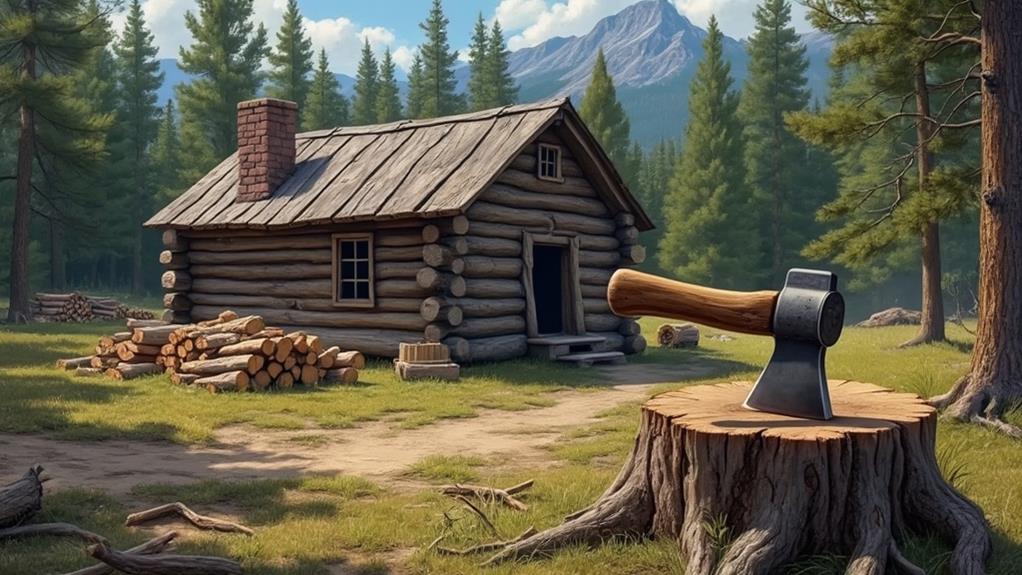
In early America, using an axe was essential for tasks like clearing land, building shelters, and gathering firewood. Mastery of techniques such as notch work for felling trees and girdling for firewood production was crucial. These skills not only fulfilled practical needs but also symbolized strength and self-sufficiency in taming the wilderness.
Essential Homesteading Tasks
Axes were fundamental to essential homesteading tasks for early American settlers, making the strenuous work of clearing land and constructing homes more manageable. As a wedge with a cutting edge, an axe was primarily used to prepare land for agriculture, allowing settlers to transform dense forests into productive fields. This tool's efficiency significantly shaped the American landscape and homesteading culture.
Here's how an axe served various essential tasks:
- Clearing Land: Settlers used axes to cut down trees and remove brush, preparing the soil for planting crops.
- Building Shelters: Axes enabled settlers to fell trees and shape logs, allowing them to build sturdy cabins within a week.
- Firewood Preparation: An axe was crucial for cutting and splitting wood, providing necessary fuel for heating and cooking.
- Crafting Tools and Furniture: Settlers used local timber to create essential tools and furniture, demonstrating their craftsmanship and resourcefulness.
Axes weren't just tools but vital companions in the daily life of a homesteader. They played a critical role in transforming the wilderness into thriving homesteads, illustrating the resilience and ingenuity of early American settlers.
Clearing and Building Techniques
Transforming the untamed wilderness into productive farmland and habitable shelters required ingenuity and practical techniques from early American settlers. Axes were pivotal for clearing land and constructing shelters, essential tasks for establishing homesteads. By 1900, approximately 500 million acres of forestland had been cleared, primarily through axe work. The adaptation of European axes to handle the larger North American timber led to the creation of heavier, shorter designs ideal for felling trees and splitting them into usable lumber.
To construct shelters, techniques like notch work and girdling trees were employed. Girdling involved cutting around the bark to kill trees, providing firewood and clearing space for farming. Notch work allowed logs to fit together tightly, enabling the construction of a basic cabin in about a week. Beyond felling trees, axes were indispensable for limbing branches and splitting wood, making them a versatile tool in everyday life.
| Technique | Purpose | Result |
|---|---|---|
| Felling | Clearing land | Open space for farming |
| Notch Work | Constructing shelters | Sturdy cabins |
| Girdling | Clearing & firewood | Dead trees, firewood |
| Limbing | Removing branches | Usable wood |
| Splitting | Fuel preparation | Firewood |
Axes were truly the backbone of early American homesteads, enabling settlers to transform the wilderness into livable, productive land.
Decline and Resurgence
The mid-20th century witnessed a notable decline in axe usage as chainsaws revolutionized logging and land clearing, rendering traditional axes less essential.
With the rise of mechanized tools, the demand for traditional tools diminished significantly. Consequently, by the late 20th century, many axe manufacturers either merged or relocated, often producing lower-quality, mass-produced axes for casual users. This period marked a significant downturn in the history of axes.
However, a resurgence of interest in traditional craftsmanship emerged. Boutique makers began producing premium axes that blend functionality with historical significance.
Enthusiasts, drawn to the superior quality and edge retention of vintage models, sought them out for restoration and practical use. This revival has been fueled by a renewed interest in woodcraft and outdoor skills.
Collectors and hobbyists have also significantly contributed to this revival. Auctions and online platforms now facilitate the buying and selling of rare models, making collectible American axes a thriving market.
To participate in this revival:
- Seek out vintage models for their quality and craftsmanship.
- Explore boutique makers for premium, historically significant axes.
- Engage with online communities and auctions for rare finds.
- Restore traditional tools for practical use and historical preservation.
This renewed interest ensures that the legacy of axes in American history is cherished and preserved.
Axe Components
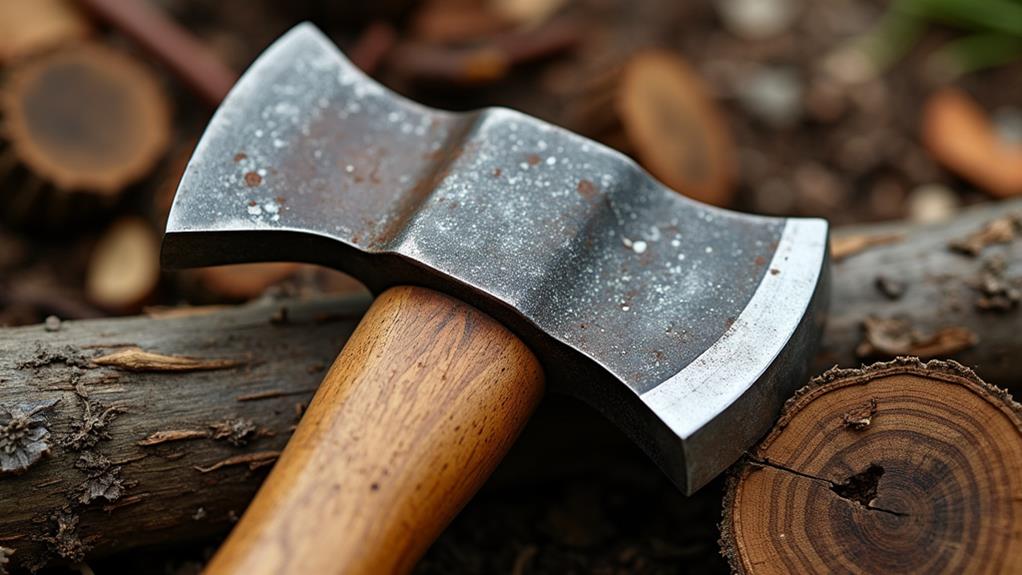
Understanding the components of an axe is fundamental for anyone interested in its effective use and maintenance. An axe consists of three main parts: the head, handle, and wedge. Each part plays a vital role in the axe's functionality and effectiveness, whether you're splitting logs or felling trees.
The head of the axe can vary in shape and weight. Felling axes typically have a heavier head, making them ideal for cutting through timber efficiently. The handle's length affects the swing and control; longer handles provide increased leverage, while shorter handles offer better maneuverability for precision work. The wedge, usually made of wood or metal, secures the head to the handle and enhances splitting effectiveness by driving the axe deeper into the material.
Customizing these components based on your personal preferences and specific tasks can significantly optimize performance. Here's a quick breakdown of the main parts:
| Component | Material | Functionality |
|---|---|---|
| Head | Metal | Cutting/Chopping |
| Handle | Wood/Composite | Leverage/Control |
| Wedge | Wood/Metal | Securing/Improving Splitting |
Selecting the Right Axe
Choosing the right axe is essential for various homesteading tasks. Functionality should take precedence over size. A single-bit axe is often the most versatile for both chopping and splitting tasks.
When evaluating axes, consider these key aspects:
- Handle Length: The handle length affects your swing and control. Full-sized handles offer more power, while 3/4 handles provide better maneuverability.
- Customization Options: Select between straight or curved handles and materials like hickory or synthetic to match your comfort and specific needs.
- Head Profile and Bit Quality: The head's profile influences how well the axe penetrates wood, and the bit quality is crucial for maintaining a sharp edge.
- Overall Condition: Ensure the axe is in good condition. Many store-bought axes may appear appealing but could lack proper balance and weight for effective use.
Conclusion
In early American homesteading, axes were essential tools, vital for building shelters, clearing land, and establishing farms. The evolution of axe design reflects the ingenuity and regional adaptations that shaped homesteading culture. Although modern technology has diminished their necessity, axes have experienced a revival among enthusiasts who value their historical significance and practical utility. Selecting the right axe connects you to this enduring legacy.