The Importance of a Proper Swing Angle With an Axe
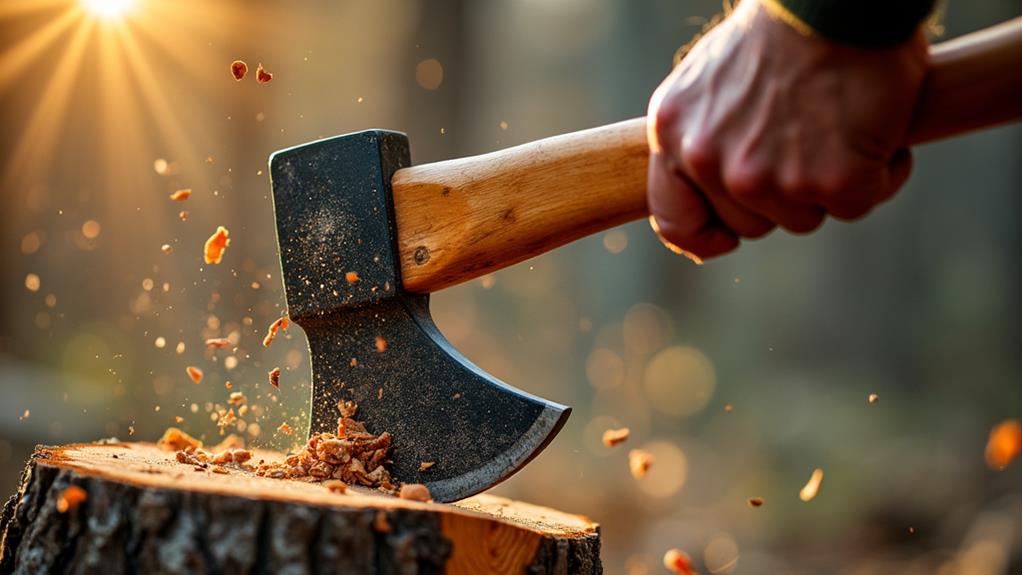
Swinging an axe at the correct angle is crucial for both effective woodcutting and safety. An optimal swing angle, typically around 45 degrees, combines power with precision, making each chop more efficient. This angle allows the axe to penetrate deeper, reducing the likelihood of missing your target and causing injury.
Why does this angle matter so much, and how can you consistently achieve it? Let's explore the key factors that enhance your technique.
Basics of Axe Swinging
Understanding the correct angles is fundamental for both effectiveness and safety when swinging an axe. For the initial face cut, aim for an angle of around 45 degrees. This ensures optimal penetration and enhances cutting force, making your efforts more efficient.
Maintaining a vertical swing is crucial for tasks like limbing and bucking, as it improves accuracy and control, reducing the risk of accidents and enhancing cutting efficiency.
When felling trees, use a lateral swing with your body offset to position the target in front of your lead foot. This stance helps maintain balance and power during the cut. The angle of your cut greatly impacts safety; steeper angles can cause the axe to stick or glance off the wood, which can be hazardous. Therefore, practicing controlled strokes at a consistent angle is essential.
Developing muscle memory through repeated, accurate swings will enhance your efficiency and ensure safer axe handling. By focusing on these basics, you'll improve both your effectiveness and safety, making your work smoother and more precise.
Role of Swing Angle
Understanding the role of your swing angle is crucial for achieving optimal cutting efficiency, safety, and precision. A steeper angle enhances penetration, whereas a 45-degree angle balances power and control, making it ideal for felling trees. For limb removal, a more vertical swing minimizes injury risk and ensures effective branch severance.
Optimal Cutting Efficiency
Achieving optimal cutting efficiency with an axe requires mastering the swing angle. The ideal swing angle, typically between 30 to 45 degrees, is crucial for effective wood penetration and fiber separation. A steeper angle increases resistance and can cause the axe to stick, whereas a shallower angle may not generate sufficient force. Maintaining the correct swing angle enhances kinetic energy transfer, ensuring the axe head contacts the wood along the swing's trajectory for maximum efficiency.
Consistent swing angles result in uniform cuts, essential for tasks like bucking and splitting wood. Practicing controlled swings at the optimal angle improves cutting accuracy and reduces fatigue, making wood processing more efficient.
Here's a breakdown:
| Swing Angle | Benefits | Challenges |
|---|---|---|
| 30-45 degrees | Ideal cutting efficiency | None if maintained |
| >45 degrees | Increased penetration | Potential stickiness |
| <30 degrees | Easier swings | Insufficient force |
Understanding and maintaining the ideal swing angle is pivotal for effective and efficient wood processing.
Safety and Precision
Mastering the swing angle of your axe is crucial for both safety and precision. A steeper swing angle increases the risk of deflection and potential injury. Instead, aim for a flatter swing angle to enhance control and cutting effectiveness. Proper technique, with a swing angle around 45 degrees for face cuts, helps create a hinge that makes tree felling safer and more efficient.
Maintaining a consistent swing angle improves accuracy by allowing you to repeatedly target the same striking point. This repetition boosts muscle memory, enhancing your overall axe handling. A controlled swing at the correct angle minimizes energy wastage, enabling deeper cuts with less effort. This not only increases cutting effectiveness but also reduces fatigue during prolonged use.
Practicing with varied swing angles helps you understand the relationship between angle, momentum, and cutting power. Through this practice, you'll develop a better sense of how to adjust your swing for peak performance, leading to more effective and safer axe handling.
Impact of Momentum
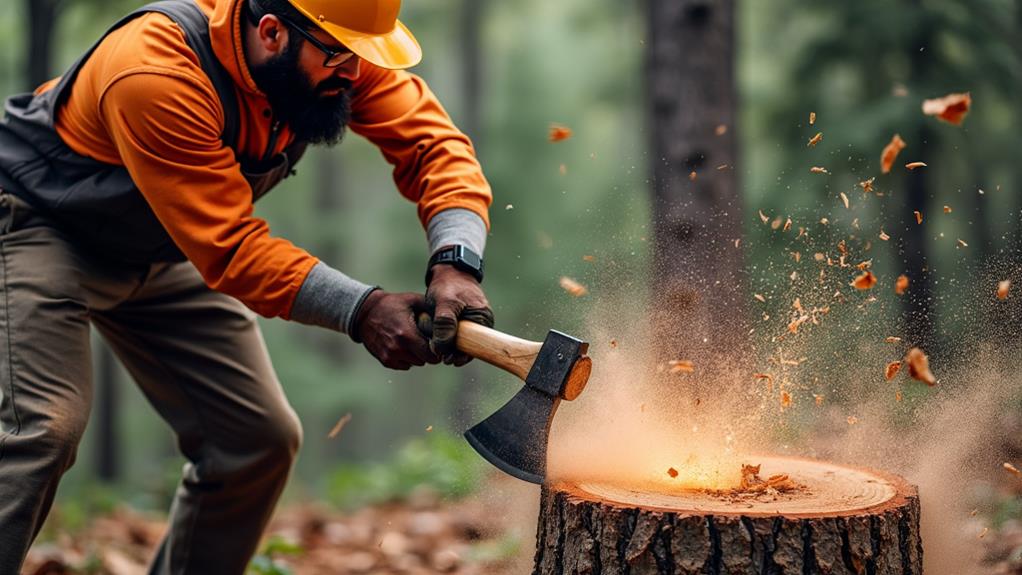
Momentum is crucial for the efficiency and depth of each cut when using an axe. It combines the mass of the axe and the velocity of your swing, directly influencing the effectiveness of each cut. Correct swing mechanics, such as using hip rotation and upper body torque, can greatly enhance momentum, resulting in more efficient cuts with less effort.
The swing angle is significant for directing momentum. A level swing path ensures that most of the axe's kinetic energy is transferred into the wood, improving the cutting process. For a lighter axe, a faster swing is necessary to generate sufficient momentum, making an optimized swing angle essential for maintaining both speed and control.
Maintaining a stable posture is key to preserving momentum and ensuring accurate strikes. Avoid excessive lunging or overreaching to maintain better control over the axe.
Energy Efficiency
To enhance energy efficiency when swinging an axe, master techniques that align with the wood grain. The handle length is crucial for balancing force and control, ensuring effective swings. Proper angle maintenance reduces fatigue, making each cut with minimal effort.
Optimal Swing Techniques
To maximize the energy efficiency of your axe swing, mastering the ideal swing angle and technique is essential. An optimal swing angle of approximately 45 degrees leverages the axe's kinetic energy effectively, enhancing cutting power while maintaining control.
By utilizing your body weight and torque, you can drive the axe down with greater force, making the movement more energy-efficient and less dependent on arm strength alone.
Here are key techniques to achieve this:
- Maintain a Level Swing Path: Keeping your swing level at the point of impact enhances penetration depth and chip removal efficiency, resulting in cleaner cuts and reduced fatigue.
- Practice Rhythmic Swinging: Consistent movements build muscle memory, improving speed and accuracy while minimizing wasted energy.
- Incorporate Effective Hip Rotation: Integrating hip rotation into your swing mechanics significantly boosts swing power, conserving energy and allowing for prolonged chopping sessions without excessive fatigue.
- Combine Proper Swing Techniques: Focus on integrating all these elements—swing angle, body weight, torque, and hip rotation—for an energy-efficient and powerful chop every time.
Handle Length Impact
After honing your swing angle and technique, it's crucial to understand how the length of the axe handle affects your efficiency. The handle length significantly influences your swing mechanics. A longer handle offers greater leverage, enhancing your swing speed and power, thereby improving cutting efficiency.
However, the ideal handle length depends on your height and reach. Typically, the axe should rest comfortably against your ankle when you're standing to ensure efficient energy transfer.
If the handle is too short, you might experience excessive strain on your arms and back. Conversely, a handle that's too long can reduce your control and precision. Experienced axemen often choose handles that enable a full range of motion without compromising balance. This choice allows for relaxed yet powerful swings that maximize kinetic energy.
Studies have shown that maintaining the correct handle length can improve cutting efficiency by 20-30%. This improvement stems from better body mechanics and reduced unnecessary muscular effort during swings.
Balancing Force and Control
When perfecting your axe-swinging technique, balancing force and control is essential for maximizing energy efficiency. Proper swing angle and mechanics enhance kinetic energy transfer, ensuring effective chopping. Here's how to achieve this balance:
- Optimal Swing Angle: Aim for a swing angle between 30 to 45 degrees. This range balances power and precision, improving cutting efficiency and reducing energy use.
- Controlled Force: A steep swing angle can cause loss of control and increase energy expenditure. A flatter angle improves accuracy and conserves energy.
- Refine Your Mechanics: Proper swing mechanics are crucial. Adjusting your angle enhances cutting efficiency and reduces muscular strain, enabling longer chopping sessions without excessive fatigue.
- Achieve Balance: Balancing force and control ensures each swing is both powerful and precise, minimizing fatigue and optimizing energy use.
Mastering these aspects will enable you to chop more efficiently and extend your sessions without undue strain.
Chopping Techniques

Mastering the proper swing angle with an axe is crucial for efficient and safe chopping. A swing angle of around 45 degrees maximizes force and ensures effective penetration into the wood. To achieve this, your axe should be well-sharpened, enhancing the cutting edge for better efficiency.
Controlling the swing angle is essential; steeper angles offer more control but may demand extra energy. Your chopping techniques should emphasize maintaining a level swing path. This consistency helps achieve uniform cuts and prevents the axe from bouncing off the wood, thereby improving both safety and stability. When felling trees, adopt an offset stance and angle the axe towards the target. This position enhances both stability and power during your swing.
Practice is fundamental for mastering these techniques. Experiment with different swing angles to adapt your chopping based on the wood type and density. This adaptability can significantly enhance your overall performance.
Safety Practices
Understanding proper swing techniques isn't enough for effective axe use; prioritizing safety practices is equally crucial. When wielding an axe, ensuring safety should be your primary concern. Here are some essential safety practices to follow:
- Maintain a clear chopping area: Always ensure a two axe-length distance from any onlookers to minimize the risk of accidents during your swings.
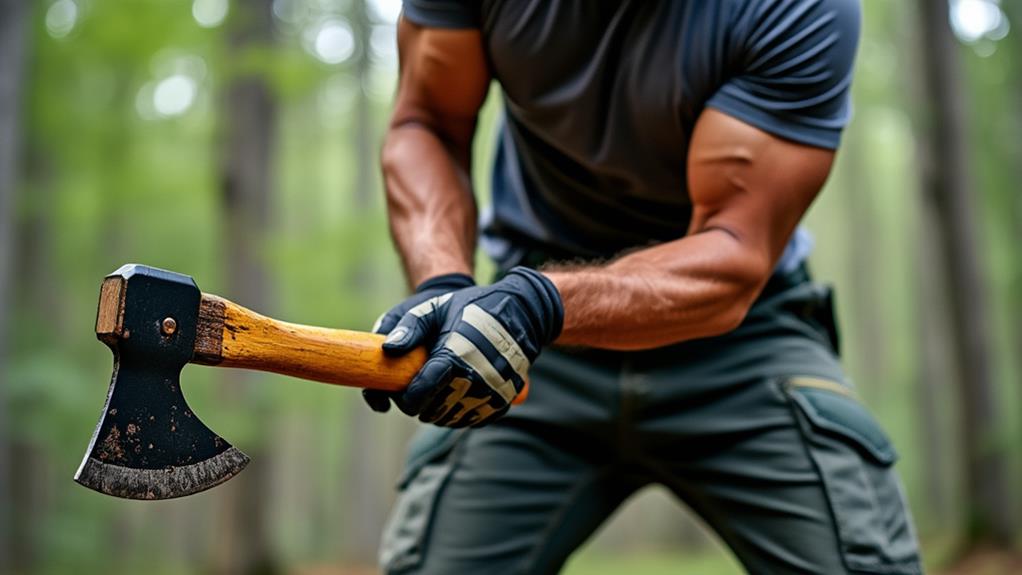
- Proper grip on the handle: Position your left hand above the knob and your right hand near the neck of the axe. This grip provides better control and stability, crucial for executing a proper swing.
- Adopt an offset stance: Stand with your feet shoulder-width apart and slightly offset. This stance improves balance and reduces the risk of losing control while chopping.
- Inspect the axe regularly: Before you start, check your axe for any signs of damage, such as cracks or a loose head. A well-maintained tool ensures safe and effective operation.
Additionally, always wear appropriate personal protective equipment (PPE), such as gloves, eye protection, and sturdy footwear, to further minimize injury risk.
Axe Maintenance
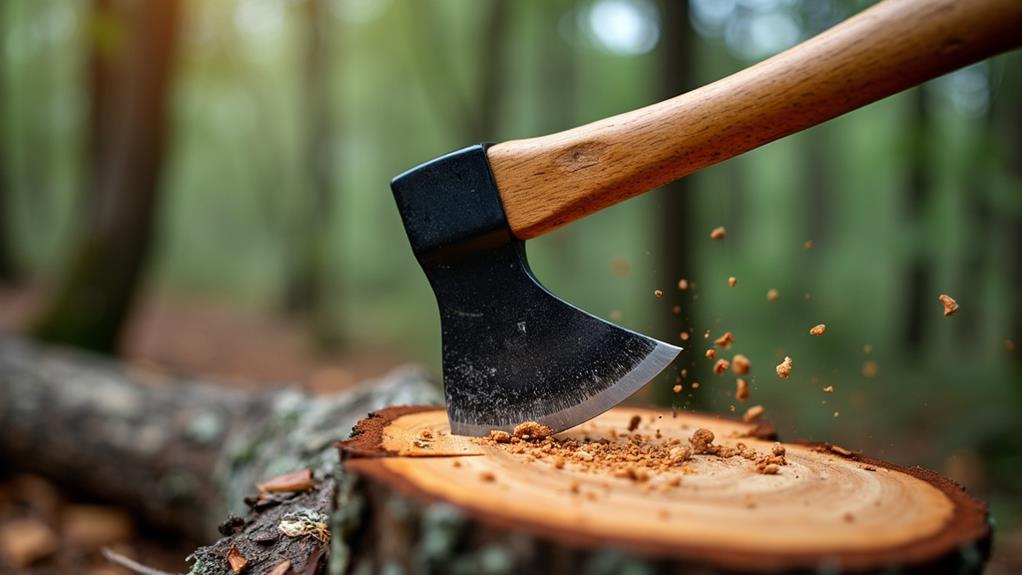
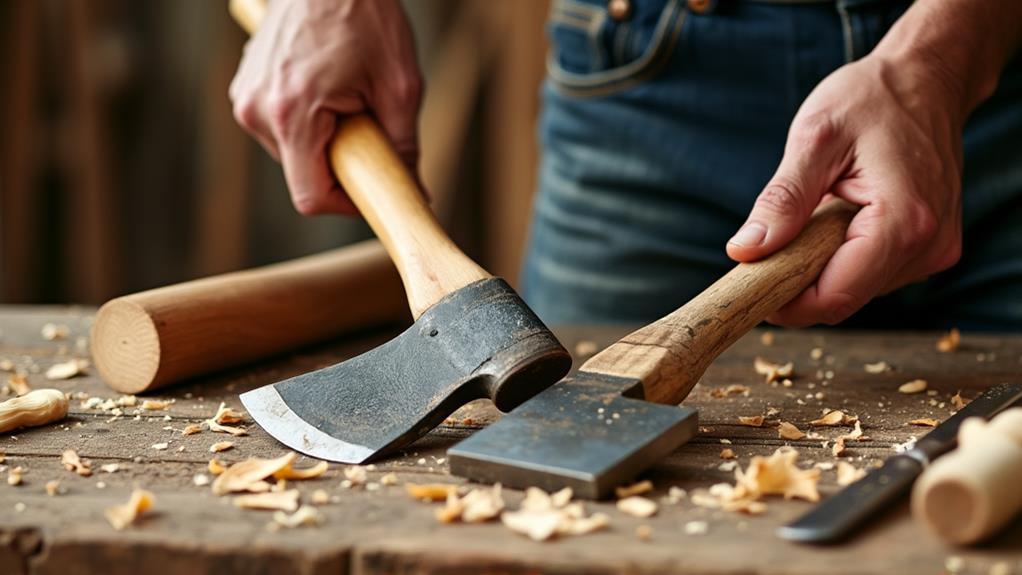
To ensure your axe remains reliable and effective, regular maintenance is essential. Start by inspecting your axe for signs of wear or damage, such as cracks in the handle or chips in the blade. This ensures you're using a safe and effective tool. After each use, clean the axe head to maintain its sharpness and prevent corrosion. Use a wire brush or cloth to remove debris and sap.
Sharpening is crucial for maintaining an effective edge. Use honing pucks and paddles, adhering to the recommended angles: 15° for softwood tasks and up to 30° for harder woods. This keeps your axe ready for any job. After cleaning, apply a protective oil to the blade to prevent rust and maintain the axe in optimal condition.
For storage, keep your axe indoors and sheathed. This protects the edge from damage and prevents exposure to moisture and extreme temperatures, which can compromise the axe's longevity.
Common Misconceptions
Maintaining your axe in top condition is just one part of effective chopping; knowing how to use it correctly is equally important. There are several common misconceptions about axe use that can hinder your chopping efficiency and safety.
- Swing Angle: Many beginners believe that swinging an axe horizontally is the most effective method. However, a proper swing angle, typically around 45 degrees, optimizes cutting efficiency and minimizes the risk of deflection.
- Cutting Power: It's a common belief that heavier axes automatically deliver more cutting power. In reality, the swing angle and the velocity at which it's executed are critical factors in achieving deeper, more accurate cuts.
- Control: Some think that a steeper angle improves accuracy. Maintaining a balanced swing angle actually enhances control and reduces the likelihood of accidents, ensuring more precise cuts.
- Body Alignment and Weight Distribution: Many new users underestimate the significance of body alignment and weight distribution. Improper angles can lead to loss of momentum and ineffective cuts.
Proper body alignment allows for better energy transfer, maximizing cutting efficiency without the need for excessive speed.
Conclusion
Maintaining a proper swing angle with an axe is crucial for efficiency, safety, and precision. A 45-degree angle is ideal for optimal penetration and minimizes the risk of injury. Consistent swings result in uniform cuts, simplifying tasks like limbing and bucking. Proper technique also enhances energy transfer, reducing fatigue. Combining correct form with regular axe maintenance ensures a smoother, safer chopping experience. Swing smart and stay safe!