The Differences Between Axes and Tomahawks
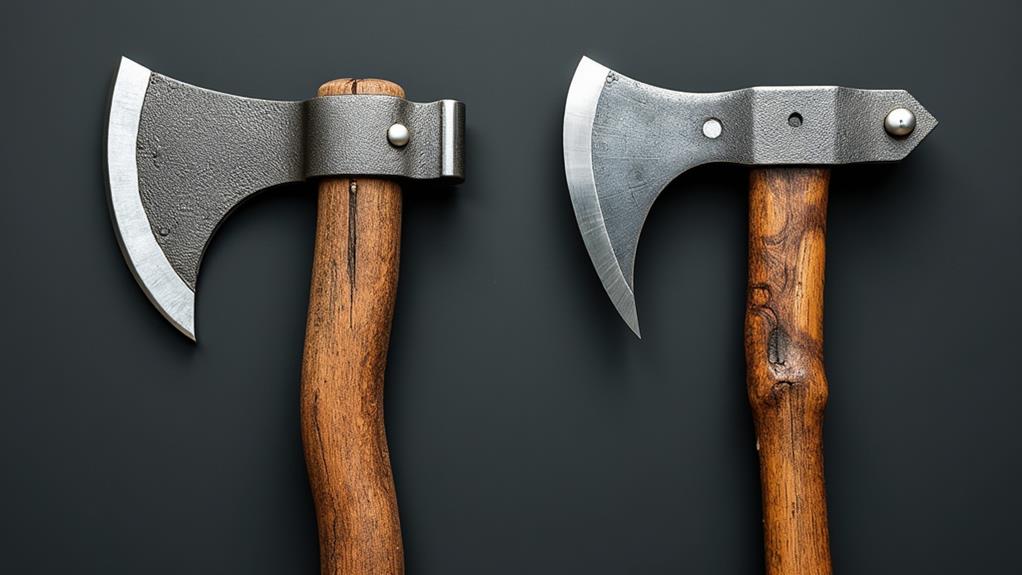
When comparing axes and tomahawks, you'll notice distinct differences in design and functionality tailored to specific tasks. Tomahawks, being lighter and more agile, are ideal for precision tasks such as throwing and light chopping. In contrast, axes, with their heavier and wedge-shaped blades, are suited for demanding activities like felling trees and splitting wood.
The attachment methods of their handles also reflect their unique cultural origins. Interested in how these tools evolved from their historical contexts to modern applications? There's much to explore about their specialized uses and maintenance requirements.
Historical Context
Exploring the historical context of tomahawks and axes reveals distinct yet interconnected narratives. Tomahawks, derived from the Algonquian word for hatchet, were primarily used by Native Americans during early colonial interactions. Initially made from stone, these tools evolved significantly when Europeans introduced metal, enhancing their durability and efficiency. As a result, tomahawks became versatile instruments utilized for both combat and trade, symbolizing Native American heritage and adaptability.
Conversely, the axe has its origins in simple stone tools used by early humans. By attaching wooden handles, these rudimentary tools became more effective for cutting and splitting wood. With strong roots in European woodworking traditions, the axe was essential in daily life, reflecting a cultural emphasis on craftsmanship and utility.
Despite their different origins, both the tomahawk and the axe evolved in response to the needs of their respective cultures. The tomahawk's lineage is deeply embedded in Native American practices, while the axe represents European ingenuity.
Understanding these historical contexts highlights the rich, intertwined heritage of these iconic tools, each adapted for specific purposes over centuries.
Design Characteristics
Understanding the historical roots of tomahawks and axes is crucial to appreciating their distinct design characteristics. When comparing their designs, you'll notice significant differences in handle connection, blade shape, and weight distribution.
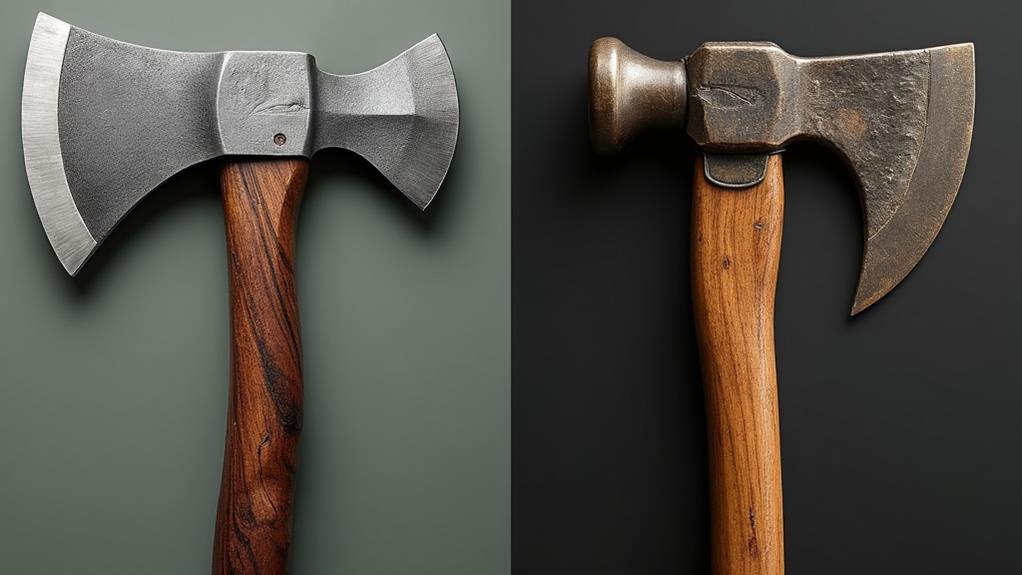
Tomahawks typically feature a round eye for the handle, providing a unique hafting method compared to the narrow, triangular eye of axes. This design affects assembly and maintenance.
| Design Element | Tomahawks | Axes |
|---|---|---|
| Handle Connection | Round eye | Narrow, triangular eye |
| Handle Length | Longer relative to head weight | Shorter relative to head weight |
| Blade Shape | Flat blade with pointed end | Thicker, wedge-shaped blade |
| Extra Features | May include hammer-like back | Specific tasks (e.g., felling) |
| Weight Distribution | Lighter, improves control | Heavier, suited for heavy-duty tasks |
Tomahawk handles are generally longer relative to the head weight than those of axes, offering greater control during use. Tomahawk heads often have flat blades with pointed ends, making them versatile for chopping and throwing. In contrast, axes feature thicker, wedge-shaped blades optimized for splitting and chopping.
Modern tomahawks may include features like a hammer-like back for added utility, whereas traditional axes are designed for specific tasks, such as felling trees. The lighter weight distribution of tomahawks enhances agility and control, while the heavier build of axes makes them ideal for demanding, heavy-duty tasks.
Functional Differences
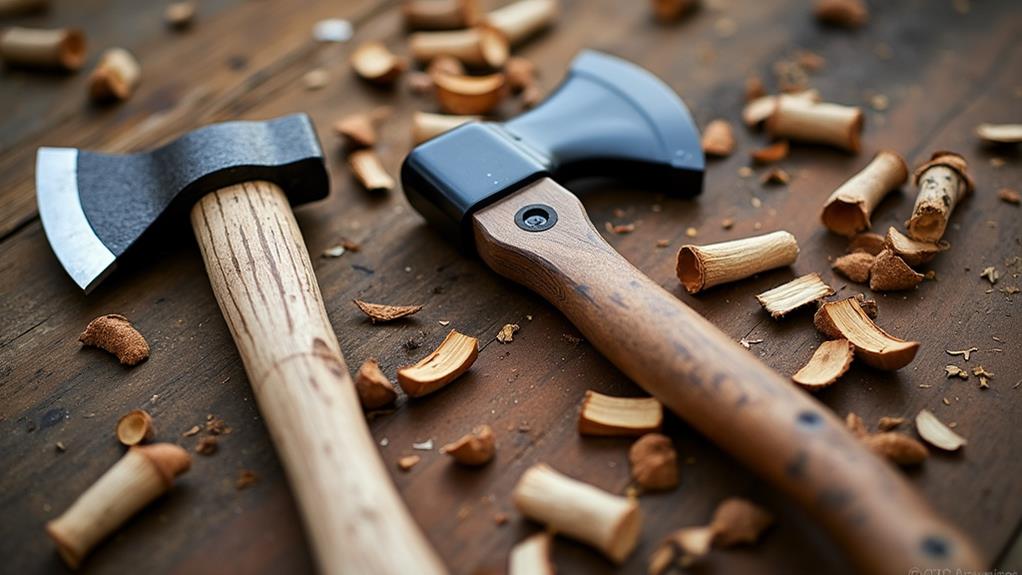
Tomahawks and axes serve distinct purposes due to their unique designs. Tomahawks, characterized by their lighter heads and longer handles, are ideal for combat and throwing. In contrast, axes, with heavier heads and shorter handles, are specifically designed for chopping and splitting wood. This specialized construction ensures each tool performs efficiently in its intended application.
Primary Uses Divergence
Tomahawks and axes, though similar in appearance, serve distinct purposes that highlight their functional differences. Tomahawks are primarily used for combat and trade, thanks to their lightweight design, which allows for quick, agile strikes. They're also useful for throwing and handling lightweight camp chores.
In contrast, axes and hatchets, including small axes, are designed for chopping, splitting, and woodworking tasks. Their heavier heads and optimized blade geometry make them highly efficient for controlled tasks like chopping wood or preparing firewood.
In a survival scenario, the choice of tool can make a significant difference. Tomahawks offer versatility—they can assist with shelter building, resource gathering, and even light combat. However, their effectiveness diminishes in heavy-duty applications. Axes, with their robust build, provide the strength needed for more demanding tasks, such as felling trees, splitting logs, and butchering.
Both tools have their place, but understanding their primary uses is vital. While tomahawks excel in agility and versatility for lighter tasks, axes stand out for their power and efficiency in heavy-duty applications. Choose wisely based on your specific needs.
Design and Structure
The design and structural differences between tomahawks and axes significantly influence their functionality. Tomahawks typically feature a round eye for handle attachment, contrasting with the narrow, triangular eye of axes. This design difference reflects their distinct hafting methods. Tomahawks have longer handles relative to the head weight, enhancing their suitability for chopping or throwing.
The blade design also varies notably. Tomahawks often have a flat blade with a pointed end, making them versatile tools for various tasks. In contrast, axes usually have a thicker, wedge-shaped blade optimized for splitting and chopping, underscoring their specialized nature.
Handle attachment methods further distinguish these tools. Tomahawk handles are inserted from the top of the head and held by friction, whereas axe handles are typically attached via a wedge from the bottom. Modern tomahawks may also feature a hammer-like back, adding utility beyond cutting, which is less common in traditional axe designs.
| Feature | Tomahawk | Axe |
|---|---|---|
| Eye Shape | Round | Narrow, Triangular |
| Blade Design | Flat blade with pointed end | Thicker, wedge-shaped blade |
| Handle Attachment | Inserted from top, secured by friction | Attached via wedge from the bottom |
These design elements ensure each tool excels in its intended applications, providing distinct advantages based on their structural characteristics.
Efficiency and Application
Both tomahawks and axes are expertly designed for their specialized tasks, offering unique advantages in their respective applications. A tomahawk's lightweight construction allows for swift, agile movements, making it ideal for combat, throwing, and precision tasks. Its flat blade and pointed end provide versatility, making it an essential tool for camping and survival situations.
Conversely, axes, including hand axes, are engineered for more demanding tasks. Their heavier heads are designed to deliver substantial force, making them perfect for chopping and splitting wood. The thicker, wedge-shaped blades of axes optimize them for efficient cutting, essential for felling trees or preparing firewood.
In practical terms, a tomahawk is well-suited for lighter tasks such as setting up camp or handling emergencies in the wilderness.
However, if your objective is to split wood for a fire or engage in extensive wood processing, the power and efficiency of an axe are unparalleled. Each tool's design enhances its effectiveness in its specialized role, ensuring you have the right tool for the job.
Modern Interpretations
In today's outdoor culture, modern interpretations of tomahawks underscore their versatility for various activities. Contemporary designs often emphasize both chopping and throwing, which can sometimes lead to misunderstandings about their traditional uses.
Social media has significantly contributed to their rising popularity, with numerous videos showcasing their application in survival skills and recreational throwing sports.
Modern tomahawks frequently incorporate materials like fiberglass and advanced steel, which diverge from historical models and can obscure the craftsmanship distinctions that defined their traditional uses. These tools are now seen as agile and precise, in stark contrast to the heavier, strength-focused nature of axes. This shift highlights a change in their functional emphasis.
To understand the versatility of modern tomahawks, consider these four key points:
- Materials: Modern tomahawks use advanced materials to enhance durability and performance.
- Activities: They're popular in both survival skills and recreational throwing sports.
- Education: Outdoor workshops increasingly feature tomahawks, promoting traditional craftsmanship.
- Designs: Newer designs prioritize agility and precision over the brute force of traditional axes.
Usage Considerations
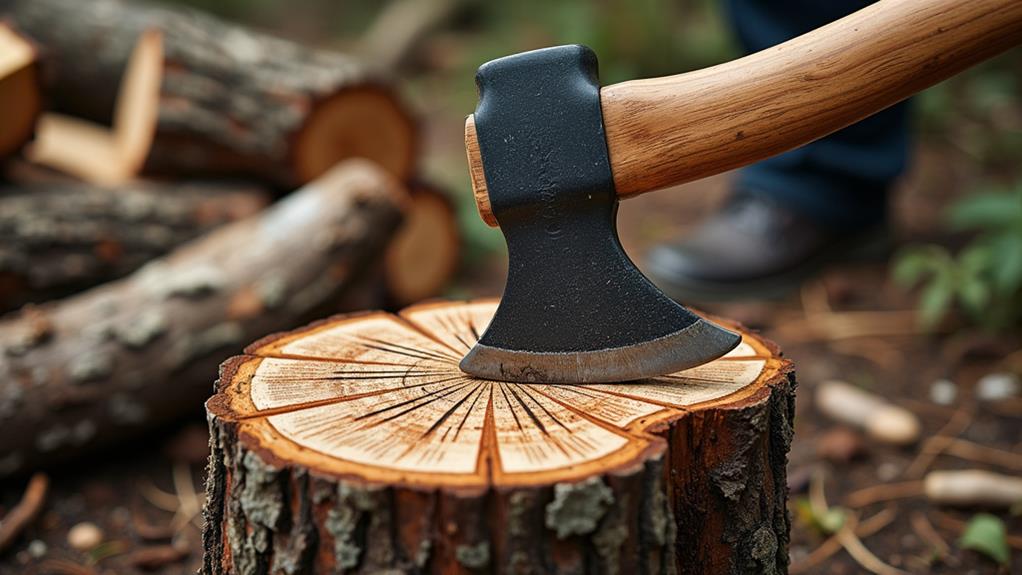
When considering usage, note that tomahawks excel in terms of weight and portability, making them ideal for quick tasks and easy to carry. Their efficiency is best seen in light chopping and throwing, while axes are more suitable for heavy-duty jobs like splitting logs. Regular maintenance and proper technique are crucial for both tools to ensure safety and longevity.
Weight and Portability
Tomahawks are distinguished by their lightweight design, typically featuring heads that weigh between 1 to 2 pounds. This makes them exceptionally portable and easy to carry during extended outdoor activities.
When navigating through the wilderness, you want to avoid being encumbered by heavy gear. The tomahawk's design ensures it can be comfortably carried, whether it's strapped to your belt or stowed in your backpack.
In contrast, axes are built for heavier-duty tasks and generally weigh between 3 to 5 pounds or more. This additional weight can make them cumbersome to transport over long distances. The bulkier design of axes also necessitates more storage space, complicating efficient packing.
Reasons why tomahawks excel in weight and portability:
- Lighter weight: Weighing 1 to 2 pounds, they're easy to carry for extended periods.
- Compact design: Fits easily into backpacks or can be carried on a belt.
- Agility: Ideal for quick and precise strikes in survival situations.
Task-Specific Efficiency
Tomahawks, with their lightweight and versatile design, excel in tasks like throwing, light chopping, and combat, making them ideal for activities such as shelter building and resource gathering in survival scenarios. However, their flat blades and lighter mass render them less effective for heavier tasks.
Axes, conversely, are engineered for heavy-duty tasks. Their heavier heads and wedge-shaped blades are perfect for chopping trees and splitting logs. The convex cheeks of an axe efficiently throw chips and reduce the tendency to stick in wood, making them essential for firewood preparation and woodworking tasks.
In strenuous applications, an axe is significantly more effective than a tomahawk. Ultimately, your choice between a tomahawk and an axe should be based on the specific tasks you need to perform. Understanding their unique strengths can greatly enhance your task-specific efficiency.
Maintenance and Care
Proper maintenance and care of your axes and tomahawks are essential for their longevity and effectiveness. Regular sharpening is crucial as dull blades reduce cutting efficiency and pose safety risks. After each use, clean your tools thoroughly to prevent rust and damage, paying special attention to the blade.
To maintain your axes and tomahawks effectively, follow these steps:
- Sharpen Regularly: Keep the blades sharp to ensure optimal cutting performance and safety.
- Clean After Use: Remove dirt and moisture to prevent rust and blade degradation.
- Store Correctly: Protect your tools by storing them in a sheath or case and keeping them away from moisture.
- Inspect Wooden Handles: Regularly check for cracks or splinters in the handles. Apply oil to prevent moisture damage and maintain wood integrity.
Proper storage is imperative. Using a sheath or case for the blade and storing it away from moisture preserves the edge and extends the tool's lifespan.
Regularly inspect the wooden handles for any signs of damage, as cracks or splinters can lead to accidents or tool failure. Applying oil helps maintain the wood's integrity and protect against moisture damage, ensuring the tools remain durable and dependable.
Maintenance and Care
Proper maintenance and care of your axes and tomahawks are essential for their longevity and optimal performance. Regular sharpening with tools like whetstones or files keeps the blades efficient and safe to use. Dull blades can underperform and pose safety risks.
After each use, clean your tools to prevent rust and damage by wiping them down with a dry cloth to remove moisture and debris from both the blade and handle. Proper storage is equally important. Keep your axes and tomahawks in a dry, protected environment. A sheath or protective cover can safeguard the edge and help prevent accidents.
Regularly inspect wooden handles for cracks or splinters. Applying a light coat of oil will preserve the wood and prevent moisture damage, thereby extending the lifespan of your tool. Avoid using your axes and tomahawks for purposes other than their intended use to prevent premature wear, breakage, and safety hazards.
Conclusion
When choosing between an axe and a tomahawk, it is crucial to assess your specific needs. For heavy-duty tasks like splitting wood, the robust design of an axe is ideal. Conversely, for precision and agility in activities such as throwing or light chopping, a tomahawk is more suitable. Each tool offers distinct advantages, making it important to understand their differences to select the right one for your tasks. Proper maintenance ensures long-lasting performance for both tools.